

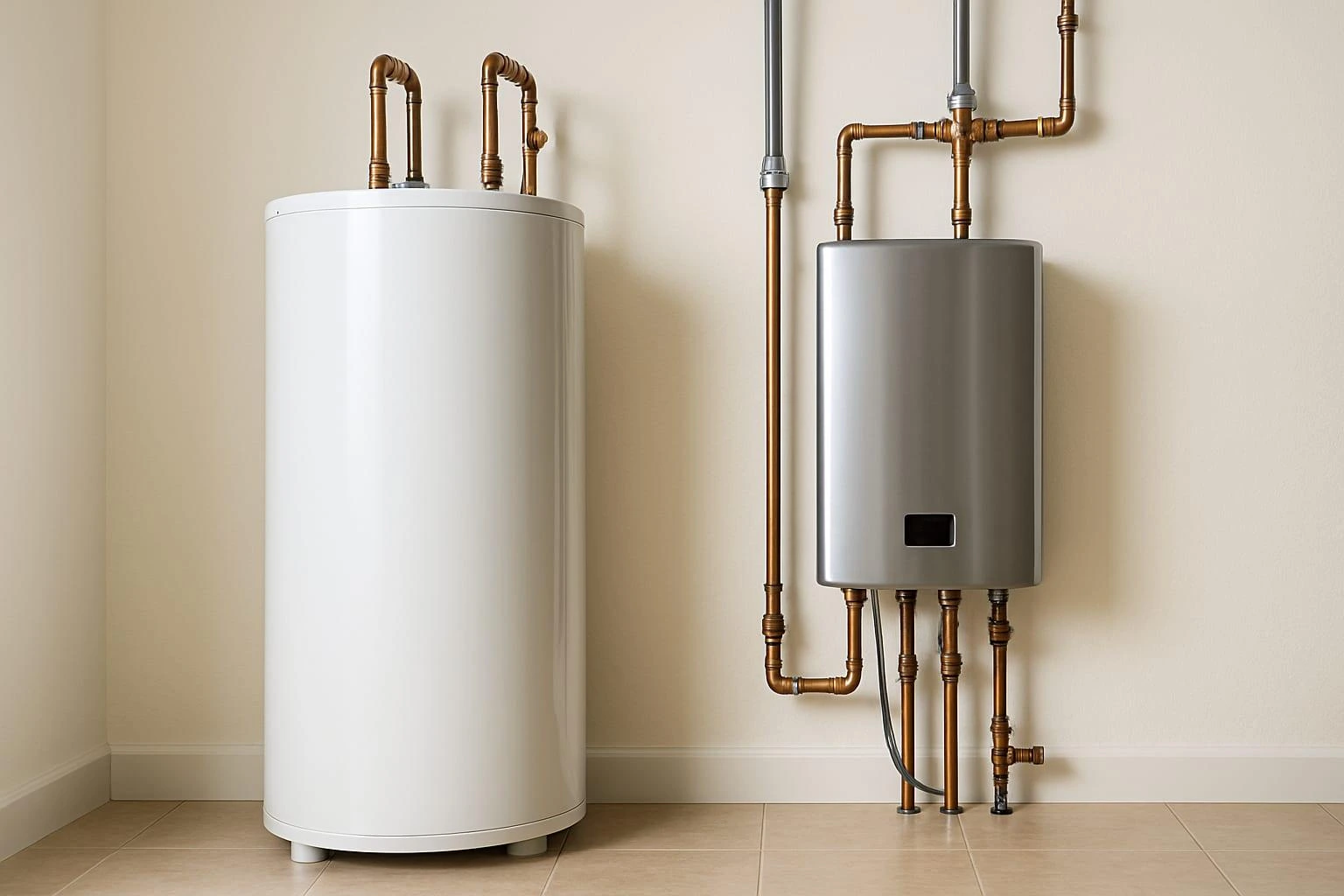
Tank vs tankless water heaters is a decision many homeowners face when their existing water heater starts failing or no longer provides enough hot water. Both systems can supply hot water for showers, laundry, dishes, and everyday household needs, but they work differently and come with different costs, advantages, and limitations.
A traditional tank water heater heats and stores a fixed amount of water. A tankless system heats water as you need it, without storing a large reserve.
A tank water heater is often the better choice for homeowners who want a lower upfront cost and a straightforward replacement. A tankless water heater can be a better investment for households that need continuous hot water, have limited installation space, and want to reduce standby energy losses.
However, a tankless system is not automatically more economical, and a conventional tank is not necessarily outdated.
For homeowners in Greater Boston and the North Shore, Massachusetts, winter water temperatures, the existing fuel supply, household size, and installation requirements can make a significant difference.
If you’re already considering an upgrade, Foukas Plumbing & Heating provides professional water heater installation and replacement services for traditional tank, tankless, hybrid, and heat pump systems.
This comparison explains which type performs better in different situations, what hidden costs to consider, and how to make a purchase decision that fits your household.
Table of Contents
-
How Tank and Tankless Water Heaters Work
-
Tank vs. Tankless Water Heaters: Main Differences
-
Upfront Cost and Installation Expenses
-
Energy Efficiency and Monthly Savings
-
Hot Water Supply and Household Demand
-
Lifespan, Maintenance, and Repair Costs
-
Gas, Electric, and Heat Pump Options
-
Seven Factors That Determine the Better Choice
-
Common Problems Homeowners Experience
-
Choosing the Right Size for Massachusetts Homes
-
Frequently Asked Questions
-
When to Schedule a Professional Assessment
How Tank and Tankless Water Heaters Work
Before comparing costs, it helps to understand what happens inside each system when someone opens a hot water faucet.
How a Traditional Tank Water Heater Operates
A conventional storage water heater uses an insulated tank to hold heated water.
Residential systems commonly come in capacities such as 40 or 50 gallons, with other sizes available depending on household needs.
When someone turns on a hot water fixture, heated water leaves the tank and cold water enters to replace it.
The thermostat controls the heating process, allowing the system to replenish its hot water supply.
This design has two important characteristics.
First, there is already a reserve of heated water available. Second, that reserve can eventually run out if hot water is consumed faster than the system can replace it.
Imagine a family where several people take showers every morning. If the second or third shower becomes noticeably colder, the water heater may be reaching its storage and recovery limits.
However, an undersized tank is not the only explanation. Faulty heating components, sediment buildup, and thermostat problems can produce similar symptoms.
Our article on why hot water runs out quickly explains how to distinguish insufficient capacity from common equipment problems.
How a Tankless Water Heater Operates
A tankless water heater warms water as it passes through the equipment.
When a hot water faucet opens, a flow sensor activates the heating system. Gas burners or electric heating elements transfer heat to the flowing water.
The system stops heating when hot water demand ends.
This reduces the need to maintain a large volume of heated water throughout the day.
Tankless technology is often described as providing endless hot water. That description is partly correct, but it can also create unrealistic expectations.
A correctly sized unit can provide continuous hot water without waiting for a storage tank to recover. However, every tankless unit has a maximum heating capacity.
If several fixtures demand more hot water than the unit can produce, performance may decline.
For homeowners interested in this technology, Foukas Plumbing & Heating offers dedicated tankless water heater installation and service.
Tank vs. Tankless Water Heaters: Main Differences
A direct comparison helps clarify the trade-offs.
| Feature | Tank Water Heater | Tankless Water Heater |
|---|---|---|
| Water heating | Heats and stores water | Heats water when needed |
| Initial equipment cost | Generally lower | Generally higher |
| Installation | Often simpler for similar replacements | May need gas, electrical, or venting upgrades |
| Hot water duration | Limited by tank capacity and recovery | Continuous within rated flow capacity |
| Energy losses | Some standby heat loss | Minimal storage-related standby loss |
| Installation space | Requires floor space | Usually compact and wall-mounted |
| Expected lifespan | Commonly 10 to 15 years | Often exceeds 20 years |
| Maintenance | Tank flushing, anode inspection, component checks | Descaling, filter cleaning, and system inspection |
| Simultaneous use | Depends on available storage and recovery | Depends on flow rate and temperature rise |
| Best fit | Budget-focused direct replacements | Space-saving and continuous hot water needs |
The U.S. Department of Energy provides the underlying efficiency and lifespan guidance in its water heating resources.
The better option depends on how these differences affect your household.
A tankless heater’s longer expected lifespan may be valuable, but not if the conversion requires expensive upgrades that outweigh the benefits.
Similarly, a storage heater’s lower purchase price may be attractive, but an undersized model may still leave a household frustrated.
Upfront Cost: Is a Tankless Water Heater Worth the Extra Money?
One of the most common questions homeowners ask is whether the higher cost of tankless equipment is justified.
The answer depends heavily on what is already installed.
Why Tank Water Heaters Usually Cost Less
Replacing an existing tank heater with a similar model typically involves less modification.
If the current plumbing connections, energy supply, venting, and installation location remain suitable, much of the existing infrastructure may be reused.
The plumber removes the old equipment, installs the replacement, completes the required connections, and checks operation.
Additional work may be necessary when existing components are damaged or no longer meet applicable requirements.
Still, replacing a similar storage unit is generally less complicated than converting to a different heating technology.
For households prioritizing a lower initial expense, this can make a conventional heater a practical choice.
Why Tankless Installation Can Be More Expensive
Tankless units are physically smaller, but their heating capacity may require substantial utility infrastructure.
A gas tankless model may need higher instantaneous gas input than the existing storage heater.
Depending on the property, the conversion could involve modifications to the gas piping, venting system, combustion air arrangement, or condensate drainage.
An electric tankless system may require additional electrical circuits or greater panel capacity.
These expenses should be evaluated before buying equipment.
For example, an older Massachusetts home may have a conventional gas water heater connected to an existing vent.
Installing a tankless model could require a different venting arrangement and an assessment of the gas supply.
That is not necessarily a reason to avoid tankless technology. It simply means the installation estimate needs to include the entire project.
Foukas Plumbing & Heating provides gas line installation and gas piping services that may be relevant when a qualified installer determines that a gas system requires modification.
Compare Total Ownership Cost, Not Just the Initial Quote
A useful financial comparison includes the purchase price, installation labor, utility modifications, anticipated energy use, maintenance, repairs, and expected replacement timing.
For a hypothetical example, suppose a tankless installation costs $2,000 more than an equivalent tank replacement.
If projected savings are $100 annually, the simple payback period would be 20 years.
This is only an illustration. Actual savings depend on the particular models, hot water consumption, energy rates, and installation requirements.
It also does not account for maintenance or future repair costs.
The most reliable approach is to request itemized estimates and compare specific equipment models.
If your existing system is aging, our guide on water heater repair vs. replacement can help you decide whether a new installation is necessary.
Energy Efficiency: Does Tankless Actually Save Money?
Tankless systems can be more energy efficient because they avoid many of the standby losses associated with storing hot water.
However, efficiency improvements do not translate directly into identical reductions in utility bills.
What Federal Energy Guidance Shows
According to the U.S. Department of Energy, demand-type water heaters can be approximately 24% to 34% more energy efficient than conventional storage systems in homes using 41 gallons or less of hot water daily.
For households using around 86 gallons daily, the efficiency advantage may be approximately 8% to 14%.
These figures demonstrate that household consumption influences the relative advantage of tankless technology.
A family with heavy hot water usage may experience different results from someone living alone.
The equipment’s fuel source, efficiency rating, operating conditions, and energy costs also matter.
Why Traditional Tank Heaters Lose Energy
A storage heater maintains a supply of heated water even when no fixtures are operating.
Although modern tanks are insulated, some heat escapes over time.
The heater periodically replaces that lost energy.
This process is known as standby heat loss.
A tankless system largely avoids that storage-related energy consumption because it heats water on demand.
However, an inefficiently configured recirculation system can introduce additional energy use, and gas tankless systems have their own operating losses.
Will a Tankless Water Heater Lower Your Monthly Bill?
It may reduce water heating energy consumption, particularly when replacing a less efficient storage system.
But several factors determine actual financial savings.
Natural gas and electricity rates vary. Household hot water habits may change after installation. Maintenance requirements may also differ.
A homeowner who begins taking much longer showers because the hot water no longer runs out could offset some expected savings.
For an accurate comparison, review the Uniform Energy Factor, EnergyGuide label, fuel type, and estimated annual operating costs of the models you’re considering.
It is worth comparing heat pump water heaters as well. For some homes replacing an electric resistance tank, a heat pump system may offer substantial energy savings while retaining stored hot water capacity.
Hot Water Supply: Which System Performs Better for Families?
A water heater’s ability to supply enough hot water often matters more to homeowners than its advertised efficiency.
The key is understanding peak demand.
Tank Water Heaters Can Supply Several Fixtures at Once
A properly sized storage heater can serve multiple fixtures using its stored reserve.
For example, someone may be showering while another person washes dishes.
The system can supply hot water from the tank, even if its burner or heating elements cannot immediately replace all the energy being used.
However, once the reserve is depleted, the water temperature begins to fall.
The heater then needs time to recover.
If your household frequently experiences this problem, it may be worth checking the current unit’s first-hour rating and overall condition.
It is also worth reviewing common reasons a water heater stops producing hot water before assuming that a larger heater is necessary.
Tankless Water Heaters Offer Continuous Heating, but Limited Flow
A tankless system can provide hot water continuously as long as demand remains within its rated heating capacity.
The challenge occurs when several fixtures run simultaneously.
For example, two showers may each require about 2 gallons of heated water per minute.
Together, they require approximately 4 gallons per minute.
If the tankless heater can meet that demand at the required temperature rise, it may operate comfortably.
If not, outlet temperature or flow may be affected.
A higher advertised maximum flow rating does not automatically mean the heater will provide that flow during a Massachusetts winter.
Incoming water temperature must be considered.
Why Winter Matters for Massachusetts Homeowners
Incoming water is typically colder during winter than during warmer months.
The heater must raise that colder water to the desired outlet temperature.
For example, if incoming water is 45°F and the desired output is 120°F, the required temperature rise is 75°F.
If incoming water rises to 65°F during warmer conditions, the required temperature rise decreases to 55°F.
A tankless heater generally provides less maximum flow at a greater temperature rise.
This is why product specifications should be evaluated against realistic winter conditions rather than an ideal laboratory scenario.
In a February 2026 discussion on Reddit’s r/Plumbing community, commenters emphasized that local groundwater temperature and gas supply capacity can materially affect a tankless conversion. This reflects useful installation considerations, although individual comments are not substitutes for equipment calculations.
Lifespan and Maintenance: Which Water Heater Lasts Longer?
Expected lifespan is one reason homeowners consider the higher cost of tankless technology.
But maintenance, water quality, and installation practices can be just as important as the manufacturer’s general lifespan estimate.
Traditional Tank Water Heater Lifespan
Storage water heaters commonly last around 10 to 15 years, although some fail earlier and others remain functional longer.
Corrosion is a major concern because the tank continually stores heated water.
Most conventional steel tanks use a protective lining and a sacrificial anode rod to help limit corrosion.
The anode should be inspected and replaced when necessary according to the manufacturer’s recommendations.
Sediment can also collect near the bottom of the tank, potentially affecting heating performance.
If the tank itself develops a corrosion leak, replacing the equipment is generally necessary.
For additional details, see how long a water heater lasts and when to replace it.
Tankless Water Heater Lifespan
A properly maintained tankless water heater can often operate for more than 20 years.
Many components are replaceable, which can make certain repairs practical.
However, mineral scale can accumulate inside the heat exchanger and reduce performance.
Regular inspection and appropriate descaling help protect the equipment, particularly where water hardness is a concern.
Manufacturer requirements vary, so there is no single maintenance schedule suitable for every model.
Is Tankless Maintenance More Expensive?
Potentially.
A tankless heater may require specialized servicing and descaling, while a storage heater may need flushing, anode replacement, and inspections of heating components.
The total cost depends on local labor rates, model design, water quality, and service history.
It is sensible to ask about local parts availability before buying.
The U.S. Department of Energy notes that tankless units generally have longer expected service lives, but the actual value depends on the installation and ownership circumstances.
A routine plumbing maintenance checklist can also help homeowners recognize leaks, changes in pressure, and equipment issues before they become more serious.
Gas vs. Electric Water Heaters: Another Important Decision
Choosing between tank vs tankless water heaters is only part of the process. The energy source also matters because gas and electricity have different installation requirements and operating costs.
Gas Tank Water Heaters
Gas storage heaters use natural gas or propane to heat water inside a tank.
They can be a practical option when a home already has a suitable gas supply and venting arrangement.
Gas storage heaters may also provide relatively fast recovery, depending on the model.
However, a gas storage water heater still has a limited reserve, and it must have appropriate combustion air and venting.
Gas Tankless Water Heaters
Gas tankless units heat flowing water using a burner and heat exchanger.
They can provide substantial heating capacity, making them worth considering for households with high hot water demand.
However, a gas tankless conversion may require a properly sized gas meter and piping system.
The existing gas line should not be assumed suitable simply because it previously served a gas storage heater.
A licensed professional should evaluate the total connected gas load and the manufacturer’s installation requirements.
Electric Tankless Water Heaters
Electric tankless units use high-powered heating elements.
They avoid combustion venting, but whole-home models can require substantial electrical capacity.
The heating demand becomes particularly important in colder climates, where incoming water needs a greater temperature increase.
Before choosing an electric tankless system, have a qualified professional check the available electrical service and expected hot water flow requirements.
Heat Pump Water Heaters May Offer Another Option
An energy-efficient heat pump water heater uses electricity to transfer heat from surrounding air into stored water.
Unlike an electric resistance heater, which generates heat directly, a heat pump moves existing heat.
This can reduce electricity consumption considerably.
However, the installation area needs suitable air conditions, adequate space, drainage, and appropriate clearances.
For Massachusetts homeowners, available incentives can also influence the decision. Foukas Plumbing & Heating offers heat pump water heater services and has a guide explaining how to explore Mass Save heat pump rebates in Boston.
Check current eligibility and program terms before assuming a particular system qualifies.
Seven Factors That Determine Which Water Heater Is Better
When evaluating tank vs tankless water heaters, seven practical considerations can help you avoid choosing equipment based on advertising alone.
1. Your Household’s Peak Hot Water Demand
Think about the busiest period of the day, not just average consumption.
A household with three bathrooms used simultaneously may need substantial heating capacity even if the home’s daily hot water consumption is moderate.
Ask your installer to account for showers, sinks, dishwashers, laundry equipment, and other major fixtures.
2. Your Available Installation Budget
A direct tank replacement may be considerably less expensive than converting to tankless technology.
However, an energy-efficient tankless system may have lower operating costs over time.
Ask for written estimates identifying equipment, labor, utility modifications, permits, and any other required work.
3. Your Home’s Existing Fuel Supply
An existing gas or electric connection can influence which replacement is economical.
A new system may require changes to piping, electrical service, venting, or the installation area.
In older Massachusetts homes, these details can have a significant effect on project scope.
4. Winter Incoming Water Temperature
Colder incoming water increases the work required of any water heater.
For tankless systems, this can reduce maximum available flow.
Review the manufacturer’s performance data at an appropriate winter temperature rise rather than relying only on the highest advertised gallons-per-minute rating.
5. Water Quality and Maintenance Requirements
Mineral deposits can affect both storage and tankless equipment.
Tankless heat exchangers may require periodic descaling, while storage systems may require sediment management and anode inspections.
Ask about maintenance intervals based on the manufacturer’s requirements and your water quality.
6. How Long You Plan to Own the Home
A tankless system’s longer expected lifespan may be attractive for someone planning to stay in their home for many years.
For a homeowner planning to move soon, the initial installation expense may matter more.
Resale value should not be assumed to cover the cost difference.
7. Whether Your Current Water Heater Can Be Repaired
Sometimes the best decision is not to replace anything yet.
A faulty heating element, thermostat, or replaceable valve may be repairable.
A corroded or leaking tank generally presents a different situation.
Before purchasing new equipment, consider a professional water heater repair assessment.
Common Problems Homeowners Experience With Both Systems
Online homeowner discussions reveal an important pattern: people are often less concerned with the technology itself than with unexpected installation costs, delays in getting hot water, and future maintenance.
Those experiences provide useful questions to ask before purchasing, although they do not establish how frequently particular problems occur.
Waiting Longer for Hot Water
Tankless water heaters do not necessarily deliver hot water instantly.
The heated water still needs to travel through the home’s plumbing.
If the new heater is installed farther away from frequently used fixtures, waiting time may increase.
One homeowner in a March 2026 Reddit discussion described longer waits after a tankless conversion relocated the water heater to a different part of the home.
A recirculation system may help in some properties, but installation and operating costs should be considered.
Unexpected Electrical or Gas Upgrades
In a February 2026 homeowner discussion, the original poster reported that switching from a conventional tank to an electric tankless unit would involve substantial electrical work.
Other participants described similar concerns about panel capacity and installation expenses.
This is why a professional site assessment matters.
The equipment’s purchase price alone does not reveal the true conversion cost.
Inconsistent Hot Water Temperature
A poorly sized tankless system may struggle when several fixtures operate simultaneously.
Other possible causes include inadequate gas supply, restricted flow, scale accumulation, or malfunctioning controls.
Temperature fluctuations are not always an inherent limitation of tankless technology.
Similarly, a storage tank that produces inconsistent hot water may have a repairable mechanical problem.
Water Heater Leaks
Storage tanks may develop leaks due to corrosion, while both tank and tankless systems can leak from connections, fittings, or internal components.
Not every visible leak means the entire unit needs replacement.
If you notice water accumulating near the equipment, investigate promptly and avoid contact with electrical or gas components.
Our guide on why a water heater leaks explains common causes and when professional help is appropriate.
You can also review seven signs your water heater needs replacement before deciding whether continued repairs make financial sense.
Choosing the Right Size for Massachusetts Homes
Proper sizing is one of the most important steps in choosing a water heater.
A system that is too small may fail to meet demand. An unnecessarily large system may increase purchase costs without delivering meaningful benefits.
How to Size a Tank Water Heater
Storage heater sizing depends on the household’s peak hot water needs and the system’s first-hour rating.
The first-hour rating describes the amount of hot water a storage system can deliver during its first hour of heavy use, beginning with a fully heated tank.
This combines the stored reserve with the heater’s recovery ability.
A 50-gallon tank does not necessarily provide the same first-hour performance as another 50-gallon model.
Compare the actual ratings of available equipment.
How to Size a Tankless Water Heater
Tankless sizing depends on the required flow rate and temperature rise.
Suppose two showers each require 2 gallons per minute of hot water.
Their combined demand is 4 gallons per minute.
If cold water enters at 45°F and the desired output is 120°F, the tankless unit must support that flow at a temperature rise of 75°F.
That example does not account for additional fixtures.
A qualified installer can determine the correct design demand and compare it with manufacturer performance charts.
Which Water Heater Fits Different Household Situations?
| Household situation | Option to consider |
|---|---|
| Small household with moderate hot water needs | Tank or properly sized tankless |
| Family taking long, consecutive showers | Properly sized tankless |
| Several bathrooms operating together | High-capacity storage or appropriately designed tankless system |
| Home with limited floor space | Wall-mounted tankless |
| Home needing a lower-cost direct replacement | Conventional storage heater |
| Electric household focused on efficiency | Heat pump water heater |
| Property requiring expensive utility upgrades | Compare a conventional replacement first |
These recommendations are starting points rather than final installation specifications.
The right model should be selected after evaluating household use, incoming water conditions, the existing utility supply, and available space.
Frequently Asked Questions
Is a tankless water heater better than a regular water heater?
Not in every situation. Tankless models can provide continuous hot water within their rated capacity and reduce standby energy losses. Conventional tank heaters generally cost less to install and may be more practical for straightforward replacements.
Do tankless water heaters really save money?
They can reduce energy consumption, but actual savings depend on household hot water use, equipment efficiency, fuel prices, and installation cost. The additional purchase and installation expense may take many years to recover.
Can a tankless water heater run two showers at the same time?
Yes, if the unit can meet the combined flow demand at the required temperature rise. Colder incoming water can reduce the available flow rate, making sizing especially important in Massachusetts.
Does a tankless water heater provide instant hot water?
No. Tankless means water is heated on demand, not that hot water reaches every faucet immediately. Pipe length, flow rate, heater activation, and recirculation arrangements affect delivery time.
Are tankless water heaters more expensive to maintain?
They can be. Tankless units may require periodic descaling and specialized servicing. Tank heaters also need maintenance, including appropriate inspections and sediment management. Water quality and equipment design influence both.
How long does a tankless water heater last compared to a tank?
Traditional storage heaters commonly last around 10 to 15 years, while tankless units often have expected service lives exceeding 20 years. Actual lifespan depends on maintenance, water conditions, installation quality, and usage.
Is a tankless water heater worth it in Massachusetts?
It may be, especially for homeowners who want continuous hot water and have suitable existing infrastructure. However, colder winter inlet water temperatures can reduce available flow, and some homes require significant installation modifications.
Can I replace a 40 or 50-gallon tank with a tankless heater?
Often, yes. However, tank capacity cannot be converted directly into a tankless flow rating. An installer must evaluate peak hot water demand, incoming water temperature, gas or electrical capacity, and venting requirements.
Should I choose gas or electric tankless?
That depends on the utility service available at your property, energy costs, installation requirements, and expected hot water demand. Whole-home electric tankless systems may require substantial electrical capacity, while gas systems require appropriate piping and venting.
Should I replace my water heater if it still works?
Not necessarily. Age alone does not always require immediate replacement. However, recurring repairs, corrosion, tank leakage, inadequate hot water, and poor performance can make replacement reasonable.
When to Schedule a Professional Water Heater Assessment
The best water heater isn’t necessarily the newest or most expensive model. It is the one that reliably meets your household’s hot water needs at a cost you can justify.
A traditional storage heater may be the right solution when your current installation is suitable, your household is satisfied with its performance, and you want to control upfront expenses.
A tankless water heater may be worth considering when continuous hot water, compact equipment, and lower standby energy consumption are priorities.
For homeowners in Greater Boston and the North Shore, the decision should also account for cold incoming water temperatures, existing gas or electrical capacity, and Massachusetts installation requirements.
Foukas Plumbing & Heating provides water heater installation, tankless water heater services, and water heater replacement for homes and businesses.
An assessment of your existing system can help determine whether a direct replacement, a tankless conversion, or another water heating option makes the most sense.
Ready to compare your options? Contact Foukas Plumbing & Heating to discuss your hot water needs and request an installation estimate.