


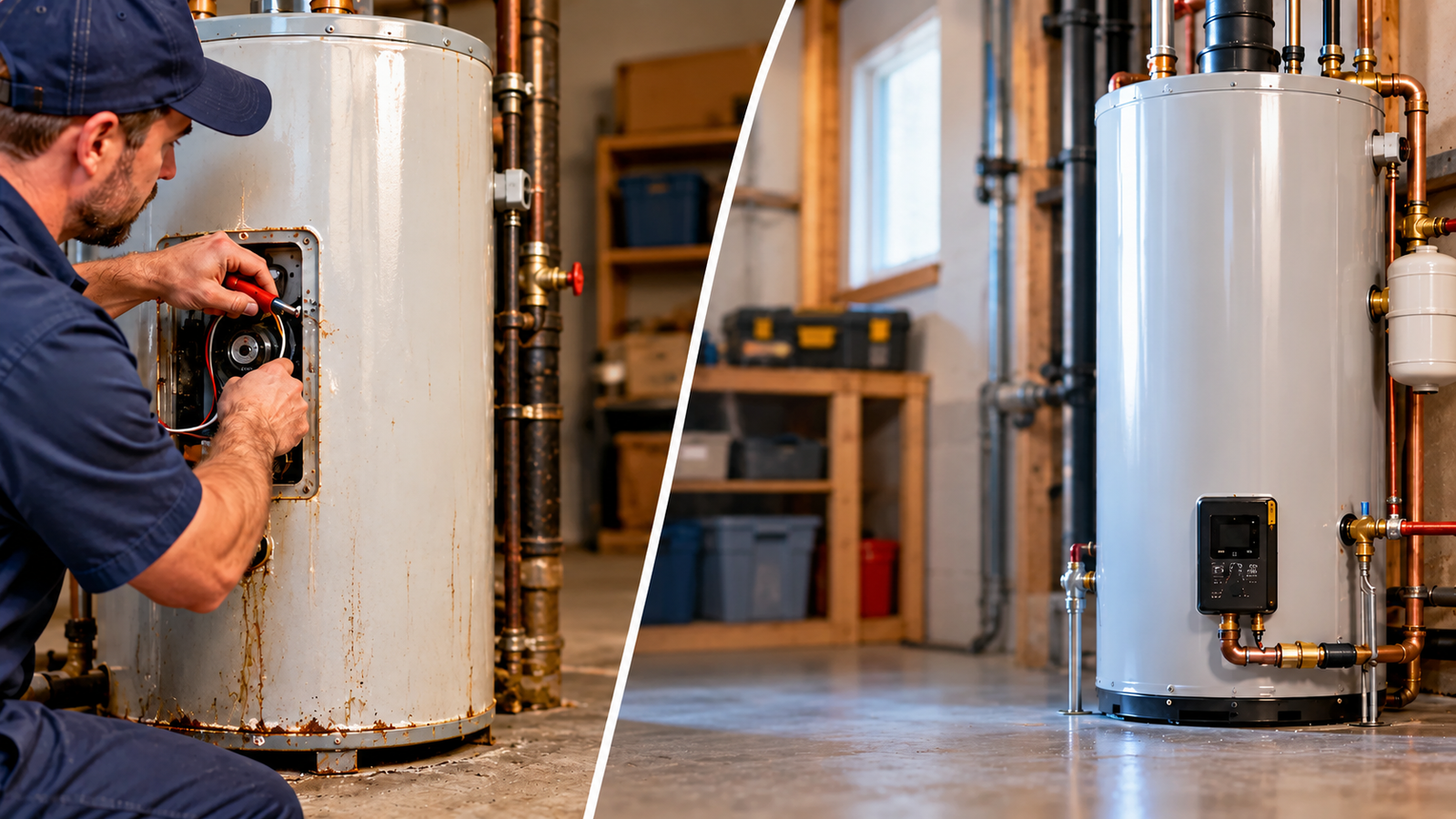
Your water heater stops producing hot water, and a plumber tells you it needs work. Now comes the expensive question: Should you pay to fix it, or would you be better off replacing the entire unit?
The answer isn’t always straightforward. A faulty heating element in a relatively new water heater might be worth repairing. A corroded storage tank that’s already approaching the end of its useful life is a different situation.
When comparing water heater repair vs. replacement, the smartest decision depends on five things: what failed, how old the equipment is, the cost of fixing it, its repair history, and how much reliable service you can reasonably expect afterward.
Repair usually makes more sense when the problem involves a replaceable component and the rest of the system is in good condition. Replacement becomes more practical when the tank is damaged, failures keep returning, or repair costs are high compared with the price of a properly installed new system.
Understanding those differences can help you make a more confident decision before authorizing either service.
Water Heater Repair vs. Replacement: A Quick Comparison
Before evaluating the costs, it helps to understand which circumstances generally favor each option.
| Factor | Repair May Make More Sense | Replacement May Make More Sense |
|---|---|---|
| Equipment age | Relatively new with useful service life remaining | Older and showing signs of deterioration |
| Type of problem | Failed thermostat, heating element, valve, or other replaceable component | Leaking storage tank or extensive internal corrosion |
| Repair costs | Low compared with installed replacement cost | High relative to the cost of a new system |
| Previous repairs | First significant problem | Multiple repairs or recurring breakdowns |
| Hot water demand | Existing system meets household needs | Existing system is consistently undersized |
| Efficiency | Equipment remains efficient and dependable | Older or poorly performing equipment has high operating costs |
| Warranty | Repair may be covered | Coverage has expired or replacement offers better long-term value |
These are guidelines rather than automatic rules. An older water heater may still justify an inexpensive repair, while a newer unit with a damaged tank could require replacement.
A professional evaluation is particularly useful when the symptoms could have more than one cause.
Start With What Actually Failed Inside the Water Heater
The type of failure is often more important than the age of the equipment.
Water heaters contain several components that can be repaired or replaced individually. A problem involving one of those components does not necessarily mean the entire system is failing.
Other failures affect the structure of the water heater itself, making replacement the practical solution.
Problems That Are Often Worth Repairing
Common repairable issues include faulty thermostats, failed electric heating elements, defective valves, damaged connections, worn sensors, and certain control problems.
Consider an electric storage water heater that suddenly stops heating water. The tank itself may be completely sound, but one of its heating elements may have failed.
Replacing that component could restore normal operation without the expense of installing a new water heater.
Similarly, moisture around a pipe fitting may be caused by a loose or deteriorated connection rather than the tank itself.
These situations are good reasons to investigate professional water heater repair before assuming replacement is necessary.
When the Tank Itself Is Damaged
A leaking storage tank is one of the clearest reasons to replace a conventional water heater.
Most traditional tank water heaters have steel tanks protected by an interior lining and an anode rod. The rod helps reduce corrosion by sacrificing itself as part of the corrosion protection system.
Over time, the lining can deteriorate and the anode rod can become depleted. Once corrosion damages the tank wall and water begins escaping, replacing an external component won’t restore the tank’s structural integrity.
A leaking fitting and a leaking tank can look similar at first. Both may leave water around the base of the equipment.
That’s why identifying the actual source matters. If water is collecting around the system and the source isn’t obvious, professional leak detection can help determine whether the issue involves a connection, nearby plumbing, or the heater itself.
Why Sediment Buildup Doesn’t Always Mean Replacement
Mineral deposits can accumulate inside storage water heaters, particularly in areas with hard water.
Sediment may cause rumbling sounds, interfere with heating performance, or reduce the usable hot water supply.
In some cases, maintenance can address the buildup. Severe deposits in an aging tank may be harder to remove, especially when other components have deteriorated.
The important distinction is whether maintenance can restore dependable operation or the condition of the equipment makes further spending unreasonable.
How Much Does Water Heater Age Affect the Decision?
The older a water heater becomes, the more carefully homeowners should evaluate the value of repairing it.
According to Rheem’s 2026 guidance, conventional storage tank water heaters typically last around 8 to 12 years. Tankless systems can often operate for 15 to 20 years or longer with appropriate care.
These are general expectations, not guaranteed service lives.
Water quality, usage, installation conditions, and maintenance can all affect how long equipment remains reliable.
Repairing a Relatively New Water Heater
Suppose a water heater has been installed for only a few years and develops a thermostat problem.
If the tank is in good condition, the warranty is active, and the repair is straightforward, replacing the whole system would often be unnecessary.
The important questions are whether the repair will resolve the problem and whether the rest of the equipment is likely to remain dependable.
Repairing an Older Water Heater
Now consider a storage water heater that has been operating for more than a decade.
It may still produce hot water, but corrosion, worn components, and previous repairs can change the financial calculation.
An inexpensive repair might be reasonable if the tank remains sound. A major repair becomes harder to justify when the remaining lifespan is uncertain.
For an aging unit with significant deterioration, water heater replacement services may offer a more dependable solution than continuing to repair individual failures.
How to Check Your Water Heater’s Age
Look for the manufacturer’s information label on the equipment.
Some manufacturers print the production date directly. Others encode it into the serial number.
Serial number formats differ between brands, so use the manufacturer’s documentation or product support resources to confirm the date.
Once you know the equipment’s age, compare it with the model’s warranty terms and condition instead of relying on age alone.
Comparing Water Heater Repair Costs With Replacement Costs
The price of the immediate repair is only part of the decision.
A low repair estimate can be attractive when you weren’t planning to purchase a new water heater. However, if another major component fails shortly afterward, that repair may provide limited long-term value.
Replacement costs more upfront, but it also means starting with new equipment and a new manufacturer warranty.
The comparison should account for the full scope of both options.
What Determines the Cost of Water Heater Repair?
Repair costs depend on the system and the specific problem.
A technician may need to diagnose the failure, replace parts, correct a connection, or perform maintenance.
The final estimate can be affected by:
- The damaged component and the availability of replacement parts
- Equipment type, brand, and model
- Labor required to access and repair the problem
- Warranty coverage
- Whether emergency or after-hours service is necessary
- Additional problems discovered during diagnosis
A repair estimate should explain what failed, what work is being recommended, and whether the repair is expected to restore reliable operation.
What Is Included in Water Heater Replacement Cost?
A new water heater requires more than purchasing equipment.
An installed replacement quote may include equipment, labor, removal of the old heater, plumbing connections, permits, and any required adjustments to the existing installation.
Additional work may be necessary when changing equipment type.
For example, converting from a storage tank to a tankless system can require changes to gas supply, venting, or electrical connections. Switching to a heat pump model may involve electrical work, condensate drainage, and installation-space considerations.
Because these requirements vary by property, an online equipment price should not be treated as a complete installed replacement estimate.
Does the 50% Rule Help?
A commonly used rule of thumb is to compare the repair cost with the installed cost of a suitable replacement.
Rheem’s published repair-versus-replacement guidance suggests that when a repair exceeds 50% of replacement cost, purchasing a new unit is often the better choice.
However, the 50% rule is only a starting point.
A costly repair on a relatively new, high-value system could still make financial sense, particularly when other components remain in good condition. Conversely, an inexpensive repair may be difficult to justify if an old tank shows substantial corrosion.
Use the rule to begin the comparison, not to make the final decision.
Why Repeated Repairs Change the Financial Equation
A single component failure is different from an ongoing pattern of breakdowns.
Imagine that a water heater requires a thermostat repair. Several months later, another component fails. Before long, the system begins losing hot water again.
Each repair may have been reasonable individually. Together, however, they suggest that the equipment may be becoming less reliable.
The problem isn’t necessarily that every component will fail. It’s that each additional repair creates another expense without establishing how much dependable service remains.
Look back at your maintenance records and ask whether the same issue keeps returning or different components are failing.
Repeated problems involving controls, heating performance, or ignition can justify a broader evaluation rather than simply repairing the next defective part.
Warranty coverage also matters here.
An equipment warranty may cover certain replacement parts while excluding labor or other expenses. Some warranties have different coverage periods for tanks, heat exchangers, and individual components.
Review the exact terms before accepting an estimate.
If the unit has undergone several major repairs, compare the combined spending and future risk against replacing it with properly sized equipment.
Will Replacing Your Water Heater Lower Energy Bills?
Energy efficiency is another factor, although it shouldn’t be the only reason to replace a functioning system.
Water heating requires energy every day. Over time, the cost of operating the equipment can become an important part of household expenses.
Older equipment may have lower efficiency than a suitable modern replacement, but actual savings depend on more than the age of the heater.
Energy source, household demand, utility rates, standby heat losses, and equipment operating conditions all affect the result.
Understanding Energy Efficiency Ratings
Many residential water heaters use a metric called Uniform Energy Factor, or UEF.
This measures efficiency under standardized testing conditions. When comparing appropriately matched models within the same usage category, a higher UEF generally indicates greater energy efficiency.
The yellow EnergyGuide label provides estimated annual operating costs under specified assumptions.
Those estimates are useful for comparing products, but they aren’t a guarantee of what your household will pay.
When an Efficiency Upgrade Is Worth Considering
Suppose your existing electric resistance water heater still works but is approaching the end of its expected life.
You may want to compare a conventional electric replacement with a heat pump model.
Heat pump water heaters use electricity to transfer heat from surrounding air into stored water rather than relying entirely on electrical resistance heating.
That process can significantly reduce electricity consumption compared with a standard electric resistance water heater.
However, a heat pump water heater must also be suitable for the installation space. Airflow, surrounding temperature, condensate drainage, electrical requirements, and household demand affect its performance.
An energy-efficient replacement may have a higher initial price, so compare the complete installed cost with realistic operating savings.
Local utility incentives or rebates may also influence the calculation, but eligibility and current program availability should always be confirmed.
Does the Decision Change for Tankless or Heat Pump Water Heaters?
Yes. Different technologies have different components, maintenance needs, and replacement considerations.
A traditional storage tank has a different failure pattern from a tankless heater, while a heat pump water heater contains additional refrigeration and airflow components.
Treating every water heater as though it has the same lifespan or repair requirements can lead to the wrong decision.
Tankless Water Heater Repair vs. Replacement
Tankless systems heat water as it passes through the equipment.
Common service problems can involve mineral scale, ignition components, sensors, flow detection, controls, or venting issues.
Some can be resolved through maintenance or the replacement of individual parts.
For example, scale buildup inside the heat exchanger may affect performance, but that doesn’t necessarily mean the entire unit has failed.
Replacement becomes a stronger consideration when a major component is damaged, suitable replacement parts are unavailable, or the equipment experiences recurring failures.
When evaluating tankless water heaters, remember that the system must also be capable of handling the home’s simultaneous hot water demand.
A tankless unit can operate correctly yet still struggle if it was undersized for the property.
Heat Pump Water Heater Repair vs. Replacement
Heat pump water heaters have components that conventional storage units don’t, including compressors, fans, sensors, and refrigerant circuits.
Some problems, such as blocked airflow, dirty filters, drainage issues, or replaceable electrical components, may be repairable.
Major compressor or sealed-system failures require a more detailed comparison of warranty coverage, repair costs, and equipment age.
A leaking storage tank generally points toward replacement, regardless of whether the water is heated by a heat pump or traditional electric elements.
Because the cost and complexity of repairs differ, use a technician familiar with the specific system.
If Replacement Makes Sense, Should You Install the Same Type Again?
Not necessarily.
Replacing an old water heater creates an opportunity to reassess how much hot water the household needs and which equipment will provide it reliably.
The existing system may have been installed before your current household routines developed.
Perhaps more people now live in the home. Maybe a bathroom has been remodeled or a large bathtub added.
An identical replacement might solve the equipment failure without correcting an ongoing capacity problem.
Start With Your Household’s Hot Water Demand
Consider when the greatest amount of hot water is used.
Back-to-back showers place different demands on a storage tank from simultaneous showers in several bathrooms.
For conventional storage water heaters, the first-hour rating helps describe how much hot water the system can deliver during a high-demand hour.
Tankless systems are commonly sized according to simultaneous flow requirements and the temperature rise needed to reach the desired hot water temperature.
These measurements provide a better basis for equipment selection than simply purchasing the same tank size as before.
Consider the Installation Requirements
The existing fuel supply, electrical capacity, venting, equipment access, and available installation space may determine which options are practical.
For example, a tankless conversion could require additional work that makes it substantially more expensive than replacing a conventional tank.
Similarly, a heat pump unit may have different space and drainage requirements.
A professional water heater installation should account for these details before the equipment is selected.
The cheapest equipment isn’t always the least expensive option over its working life. The best value comes from equipment that meets demand, is compatible with the property, and has reasonable installation and operating costs.
Questions to Ask Before Approving a Water Heater Repair
A good repair-versus-replacement decision depends on getting clear answers about the equipment’s condition.
Before committing to either option, discuss the following questions with the technician:
- What component has actually failed? Ask whether the problem is isolated or evidence of broader deterioration.
- Is the storage tank or heat exchanger still in good condition? Structural damage changes the repair decision considerably.
- What does the repair estimate include? Confirm labor, parts, additional fees, and any warranty coverage.
- Is the same problem likely to return? The answer should be based on the diagnosed cause and condition of the equipment.
- What would a comparable replacement cost, fully installed? Compare the total project cost rather than equipment prices alone.
- Would a new system meet our hot water needs better? Discuss capacity and how the household uses hot water.
- What warranty would apply to each option? Understand what is and isn’t covered after repair or replacement.
It’s also worth checking whether the water heater is actually responsible for the symptom.
Low hot water flow from one fixture, for example, may be caused by a restriction in the plumbing or fixture rather than the heating equipment.
An evaluation that includes relevant residential plumbing services can help distinguish equipment problems from issues elsewhere in the hot water distribution system.
When Water Heater Problems Shouldn’t Wait
Some water heater problems allow time to compare quotes and plan a replacement. Others require prompt attention because of the risk of injury or property damage.
Significant leaks, suspected tank failure, visible electrical hazards, and gas-related problems should never be treated as routine maintenance issues.
Water collecting near electrical components can create a shock hazard. A leaking pressurized storage tank can also release a substantial amount of water.
If you suspect a gas leak, leave the building immediately. Don’t operate electrical switches or appliances, and call 911 from a safe location outside.
Never plug or cap a temperature and pressure relief valve discharge pipe to stop water from coming out. That valve is an essential safety component, and unexpected discharge needs professional evaluation.
For urgent water heater leaks or related plumbing emergencies, emergency plumbing services can help address the problem and assess the equipment.
Only isolate water or shut down equipment when it is safe and you understand the manufacturer’s instructions. Avoid attempting electrical, gas, or pressurized-system repairs without appropriate professional qualifications.
Common Questions About Repairing or Replacing a Water Heater
Is It Worth Repairing a 10-Year-Old Water Heater?
It can be, depending on the problem.
If the water heater has a minor, inexpensive fault and the tank remains in good condition, repair may still be reasonable.
However, a 10-year-old storage heater with substantial corrosion, repeated failures, or a costly component problem may be a better candidate for replacement.
The decision should consider the remaining expected service life, repair expense, and equipment condition.
How Do I Know if My Water Heater Is Beyond Repair?
A storage tank leaking through corroded metal generally requires replacement.
Other conditions, including severe internal damage or unavailable replacement parts, may also make repair impractical.
A technician should determine whether the problem affects a replaceable component or the structure of the equipment.
Is Replacing a Water Heater Cheaper Than Repairing It?
Usually, repairing a minor component costs less upfront than replacing the entire unit.
Replacement can become more economical over time when repairs are expensive, breakdowns keep recurring, or the equipment is near the end of its useful life.
The best comparison includes both options’ total costs and the expected value of the remaining service life.
Should I Replace a Water Heater That Still Works?
Not simply because it’s old.
A functioning heater that remains reliable and shows no signs of significant deterioration may not need immediate replacement.
However, planning ahead can be sensible when a storage water heater approaches the end of its expected lifespan, particularly if it is installed somewhere a sudden leak could cause extensive property damage.
Can Regular Maintenance Help Avoid Replacement?
Proper maintenance can reduce some causes of premature failure.
Depending on the water heater type, maintenance may include inspecting the anode rod, addressing sediment buildup, cleaning filters, checking drainage, and following the manufacturer’s service recommendations.
Maintenance cannot reverse structural tank corrosion or restore a severely damaged component, but it may help a properly functioning unit remain dependable for longer.
Making the Right Decision for Your Home
The most sensible choice between water heater repair and replacement comes down to the condition of the equipment and the value of the proposed work.
A repairable component in a relatively new system is usually worth investigating. A damaged storage tank, repeated major failures, or an expensive repair on aging equipment makes replacement more attractive.
Don’t base the decision entirely on age or the price of a single repair. Compare the equipment’s condition, warranty, long-term reliability, energy use, and fully installed replacement cost.
Foukas Plumbing & Heating provides water heater services for residential and commercial properties throughout Greater Boston and surrounding North Shore communities.
If you’re uncertain whether your existing system should be repaired or replaced, contact Foukas Plumbing & Heating to request an evaluation. Understanding the actual problem and your available options is the best place to start.