

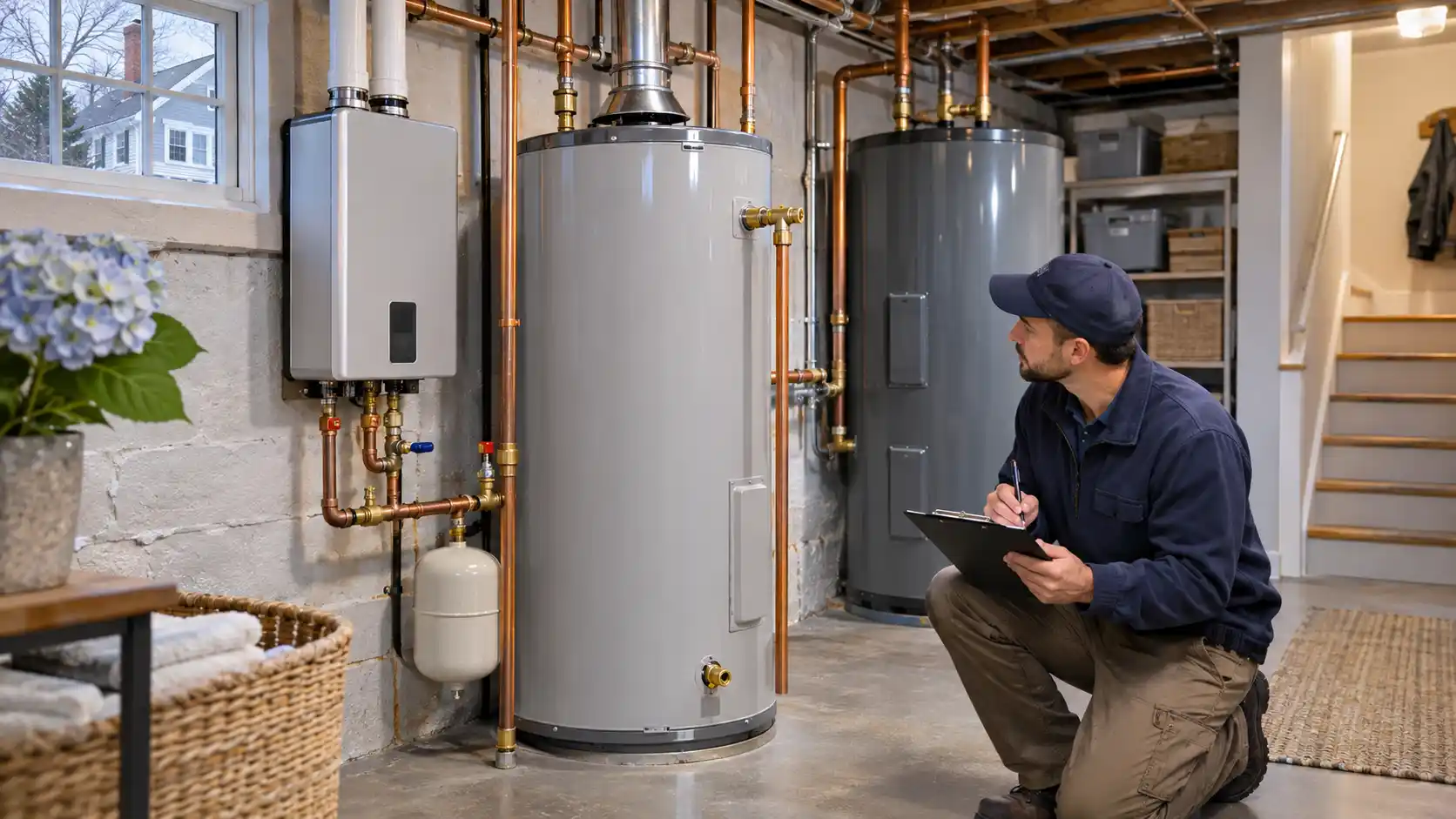
Choosing the right water heater size is not simply about buying a 40, 50, or 80-gallon tank. Your household’s hot water habits, number of bathrooms, shower duration, and water heater recovery rate all affect how much capacity you actually need.
For many households, a 40 to 50-gallon storage water heater is a reasonable starting point. Larger families, homes with soaking tubs, and households that use several hot water fixtures simultaneously may need more capacity.
But here’s something homeowners often overlook: two water heaters with the same tank capacity can deliver very different amounts of hot water.
That is why proper water heater sizing involves more than counting the people in your home.
This guide explains how to estimate your household’s hot water needs, compare storage and tankless systems, understand first-hour ratings, and avoid buying a unit that leaves your family with cold showers.
Table of Contents
-
Water Heater Size Chart: How Many Gallons Do You Need?
-
Five Steps to Calculate Your Household’s Hot Water Demand
-
Why First-Hour Rating Matters More Than Tank Capacity
-
Is a 40 or 50-Gallon Water Heater Enough for Four People?
-
How to Calculate the Right Tankless Water Heater Size
-
Why Cold Massachusetts Winters Affect Water Heater Sizing
-
Choosing the Right Heat Pump Water Heater Size
-
When a Larger Water Heater Is Worth Considering
-
Signs Your Water Heater Is Undersized or Needs Repair
-
Installation Requirements, Costs, and Massachusetts Rebates
-
Common Questions About Water Heater Size
-
Getting the Right Water Heater for Your Home
Water Heater Size Chart: How Many Gallons Do You Need?
The number of people living in your home provides a useful starting point, but it should not be your only consideration.
A household with three people taking long showers may use more hot water than a family of five taking short showers at different times.
The following chart provides broad starting ranges for conventional storage water heaters.
| Household size | Common starting tank size | Typical situation |
|---|---|---|
| 1 to 2 people | 30 to 40 gallons | Apartment, condo, or small household with moderate usage |
| 3 to 4 people | 40 to 50 gallons | Regular showers, kitchen use, and laundry |
| 4 to 5 people | 50 to 55 gallons | Multiple bathrooms and frequent back-to-back showers |
| 5 or more people | 75 gallons or a separately sized system | Higher demand, several showers, or multiple fixtures operating together |
These are general guidelines for conventional gas storage systems, consistent with manufacturer sizing guidance from Rheem. Electric resistance and heat pump models may require different storage capacities because their recovery rates differ.
A 40-gallon gas water heater with a strong first-hour rating might serve a family better than a 50-gallon electric model with slower recovery.
Similarly, a properly designed tankless system does not need a large storage tank, but it must deliver enough hot water when several fixtures are running.
Does the size of your house determine water heater capacity?
Not directly.
Square footage does not tell you how much hot water a household uses. A large house occupied by two people may need less capacity than a smaller home with six residents.
Bathroom count matters because it indicates potential simultaneous demand, but the actual usage schedule remains more important.
When evaluating residential plumbing services, homeowners should consider how their family uses the plumbing system rather than relying solely on the home’s size.
Five Steps to Calculate Your Household’s Hot Water Demand
The most useful way to estimate water heater size is to identify your busiest period of hot water use.
For many families, that happens in the morning before work and school. Other households experience peak demand in the evening when everyone showers, cooks, and does laundry.
Follow these five steps before comparing water heater models.
Step 1: Count the people who regularly use hot water
Start with the number of permanent household members.
Then consider frequent visitors, overnight guests, and any expected changes in occupancy.
A family with two young children may experience much higher demand several years later when both children start taking longer showers.
You don’t necessarily need to purchase an oversized tank for occasional visitors, but predictable future demand is worth including in your calculation.
Step 2: Identify fixtures that consume the most hot water
Showers, bathtubs, washing machines, dishwashers, and kitchen sinks all contribute to demand.
The amount varies considerably depending on the fixture and how it is used.
For example, a showerhead flowing at 2 gallons per minute delivers 20 gallons of mixed-temperature water during a 10-minute shower.
Two people taking showers of the same length use a combined 40 gallons of mixed water.
That does not mean the water heater must supply 40 gallons directly from its tank. Showers normally blend hot water with incoming cold water to reach a comfortable temperature.
To estimate the actual hot-water draw, you need to account for that mixing.
If you are planning new showers, faucets, or high-flow bathroom fixtures, professional fixture installation is also an opportunity to discuss their effect on hot water demand.
Step 3: Calculate usage during your busiest hour
Imagine a family of four with the following routine:
-
Two people take 10-minute showers using 2 GPM showerheads.
-
Someone uses hot water at the kitchen sink.
-
A washing machine begins a warm-water cycle.
The two showers produce a total of 40 gallons of mixed water.
Now assume, for this hypothetical calculation, that the incoming cold water is 50°F, the water heater stores water at 120°F, and the showers run at 105°F.
The approximate fraction drawn from the hot water tank would be:
The showers would therefore use approximately 31 gallons of tank-temperature hot water, before accounting for system losses and additional recovery.
If kitchen use draws another 5 gallons of hot water and the washing machine draws 10 gallons, the estimated peak-hour total becomes approximately 46 gallons.
These appliance draws are examples, not universal consumption values. Modern washing machines and dishwashers vary widely.
This suggests comparing storage models with first-hour ratings capable of meeting at least that estimated demand, while checking the exact model and actual household conditions.
Step 4: Check your existing water heater’s performance
Your current system provides valuable information.
Look for the manufacturer’s label, which may display the tank capacity, energy source, heating input, and model number.
Ask yourself:
Does the current water heater meet your needs most days? Does it run short only when everyone showers consecutively? Has your family grown since the unit was installed?
If the existing system consistently provides enough hot water, similar capacity and delivery performance may be appropriate when replacing it.
If your existing tank frequently runs cold, however, determine whether the problem is insufficient capacity or declining equipment performance before paying for a larger heater.
Step 5: Compare actual models, not just gallon labels
Once you have a reasonable demand estimate, compare:
-
Tank capacity
-
First-hour rating
-
Recovery performance
-
Fuel or electricity requirements
-
Installation space
-
Operating efficiency
The final water heater size should come from the model’s published specifications and your household’s demand pattern.
A plumber can review these factors during a water heater installation assessment and confirm that the selected model is suitable for the existing plumbing and utility connections.
Why First-Hour Rating Matters More Than Tank Capacity
One of the most useful specifications on a storage water heater is its First-Hour Rating (FHR).
First-hour rating estimates how many gallons of hot water a storage water heater can deliver during an hour that begins with a fully heated tank.
It considers the stored supply and the additional hot water produced as the heater operates.
The ENERGY STAR water heater criteria explain how this rating is defined and tested.
Why two 50-gallon water heaters can perform differently
Imagine comparing two 50-gallon models.
One heats replacement water more quickly. The other has slower recovery, meaning the tank takes longer to restore its supply after heavy use.
Even with identical storage capacities, the models may have different first-hour ratings.
A higher first-hour rating can help during periods when several family members shower consecutively.
However, FHR is a standardized performance measure. It is not a guarantee that every household will receive exactly that volume under every operating condition.
How should you use first-hour rating when shopping?
Suppose your estimated peak-hour demand is 55 gallons.
A logical starting point would be to compare storage water heaters with first-hour ratings of at least 55 gallons, then check how they perform under your installation conditions.
A model with an FHR of 60 gallons may be worth considering, but selecting a significantly larger tank without understanding the additional demand is not automatically necessary.
When requesting an estimate, ask the installer to identify the proposed model’s first-hour rating.
That single question can make comparisons between different water heaters much more useful.
Is a 40 or 50-Gallon Water Heater Enough for Four People?
This question frequently appears in homeowner plumbing discussions, and the answers are not always consistent.
Other participants reported that 40-gallon gas models worked for similarly sized households, particularly when showers were spaced apart.
These are individual experiences, not controlled performance tests, but they illustrate why household size alone is an unreliable guide.
When a 40-gallon water heater may be sufficient
A 40-gallon storage system may work for a family of four when showers are relatively short, the fixtures use moderate amounts of water, and hot water demand is spread across the day.
Its suitability also depends on recovery rate and first-hour delivery.
For example, a family where two people shower in the morning and two shower in the evening may place less stress on a storage tank than four people showering consecutively.
When a 50-gallon water heater makes more sense
A 50-gallon model is worth considering when family members regularly shower back-to-back, hot water appliances operate during busy periods, or the existing smaller unit cannot meet normal demand.
The increase in storage capacity can provide additional flexibility, but you should still compare first-hour ratings.
If you are replacing an existing heater, water heater replacement services can help identify whether an additional 10 gallons of storage or a different recovery rate would better solve the problem.
What about a family with five or six people?
Larger households may benefit from a 55, 65, 75, or 80-gallon system, depending on the heater technology and demand.
For example, families with multiple teenagers, large bathtubs, or simultaneous morning showers may require higher delivery capacity.
Still, not every family of six needs an 80-gallon tank.
The right decision comes from calculating demand and checking the equipment’s ability to meet it.
How to Calculate the Right Tankless Water Heater Size
Tankless water heaters operate differently from conventional storage systems.
Instead of maintaining a large supply of heated water, they heat water as it passes through the equipment.
For this reason, tankless water heater size is primarily determined by two factors: flow rate and required temperature rise.
Flow rate is measured in gallons per minute (GPM).
Temperature rise is the difference between the temperature of incoming cold water and the temperature the heater must deliver.
Step 1: Estimate simultaneous water flow
Imagine a household where two showers and a kitchen sink may run at the same time.
Assume the fixtures have these total flow rates:
| Fixture | Example flow rate |
|---|---|
| Shower 1 | 2.0 GPM |
| Shower 2 | 2.0 GPM |
| Kitchen faucet | 1.5 GPM |
| Combined fixture flow | 5.5 GPM |
The household’s simultaneous mixed-water flow would be 5.5 GPM.
However, the tankless heater may need to produce less than this amount at its higher outlet temperature because the fixtures can mix heated water with cold water.
The plumber should calculate the actual hot-water portion rather than assume every gallon passing through a fixture must be heated to the unit’s outlet temperature.
Step 2: Calculate the required temperature rise
Suppose your incoming water is 50°F and the tankless heater must produce water at 120°F.
The required temperature rise is:
Now imagine incoming water falls to 40°F during colder conditions.
The required rise increases to 80°F.
Heating colder water to the same output temperature requires more energy. A tankless model may therefore deliver less hot water per minute when incoming water is colder.
Step 3: Check the manufacturer’s performance chart
A tankless unit advertised as having a high maximum GPM may deliver that rate only when the required temperature rise is relatively small.
For an accurate comparison, request the model’s flow rating at the expected winter temperature rise.
The U.S. Department of Energy’s guidance on gas tankless water heaters recommends sizing around practical maximum flow and required temperature rise.
Does tankless mean unlimited hot water?
A properly sized tankless water heater can continue heating water while it is operating within its capacity.
But that does not mean unlimited flow.
If multiple showers demand more hot water than the heater can supply, flow or temperature performance can suffer.
Tankless equipment also does not automatically deliver instant hot water to distant fixtures. The water already sitting in the pipe must travel out before heated water arrives.
For homeowners considering this technology, Foukas offers tankless water heater services, including evaluation of household demand and installation requirements.
Why Cold Massachusetts Winters Affect Water Heater Sizing
Homeowners across Greater Boston and the North Shore should consider seasonal water temperatures when comparing water heaters.
A water heater has to work harder to bring colder incoming water up to the required temperature.
This is especially important for tankless equipment because its available flow rate depends on the temperature rise it must achieve.
For example, heating incoming water from 40°F to 120°F requires a greater temperature increase than heating it from 60°F to 120°F.
A tankless unit that serves two showers comfortably during warmer conditions may have less available capacity during colder months.
Actual inlet temperatures differ by location, water source, distribution system, and season. The figures above are examples, not measured temperatures for every Massachusetts home.
Tank water heaters are affected, too
Colder inlet water also means storage heaters must put more energy into heating replacement water.
This can affect recovery and the amount of usable hot water available during repeated draws.
Before replacing a heater, it is worth reviewing how the equipment performs during winter rather than relying only on warmer-weather experiences.
Consider the existing fuel supply
For gas-fired tankless systems, higher heating capacity can also require greater gas input.
An installer should verify whether the existing gas piping, meter capacity, combustion air, and venting arrangements can safely support the selected equipment.
Changing from a standard gas tank to a larger tankless heater may require additional work.
If the project involves new or upgraded fuel piping, professional gas line installation may form part of the installation plan.
Choosing the Right Heat Pump Water Heater Size
Heat pump water heaters use electricity to move heat from surrounding air into stored water.
Many residential systems are described as hybrid models because they can combine heat pump operation with electric resistance heating when additional heating is needed.
Their sizing requirements can differ from conventional gas storage systems.
Why a larger heat pump water heater may be appropriate
Heat pumps generally recover stored hot water more slowly when operating in heat-pump-only mode than when high-output backup resistance elements are used.
For households with frequent large draws, a larger storage tank can reduce reliance on backup heating.
ENERGY STAR recommends considering larger tanks for heat pump systems, especially in homes with heavy demand, longer showers, and frequent baths.
For example, a family replacing a conventional 50-gallon gas storage heater might compare 65 and 80-gallon heat pump options rather than automatically purchasing another 50-gallon unit.
That does not mean an 80-gallon system is necessary for every household. The unit’s actual first-hour rating, operating mode, available space, and daily usage must be considered.
What homeowners report about heat pump sizing
In a discussion about heat pump water heaters for families of four, homeowners described different experiences with 50, 65, and 80-gallon systems.
Some reported satisfactory performance from moderate-sized tanks. Others found that consecutive showers made larger storage or hybrid operation more practical.
The discussion reinforces an important point: a model’s nominal capacity does not describe the entire experience, particularly when operating modes and usage patterns differ.
Installation space matters as much as capacity
Heat pump water heaters need access to sufficient surrounding air and appropriate operating temperatures.
Many models require substantial free air volume or approved ducting. They also produce condensate that must be drained properly.
A basement or sufficiently ventilated utility room may be suitable, while a small enclosed closet can require additional modifications.
The equipment also produces some fan and compressor noise, which should be considered when choosing its location.
Homeowners exploring more efficient systems can review Foukas Plumbing & Heating’s heat pump water heater services before making a final equipment selection.
When a Larger Water Heater Is Worth Considering
Buying a larger water heater can make sense, but additional capacity should solve a specific problem.
A bigger tank is not automatically a better investment.
Your home has a large soaking bathtub
Standard showers and oversized bathtubs create very different hot water demands.
For example, imagine installing a soaking tub that requires 60 gallons of mixed water for a comfortable bath.
If the water heater cannot supply enough hot water during filling, the tub may begin losing temperature before it reaches the desired level.
The solution could involve a larger storage system, a higher recovery rate, or another appropriately designed water heating arrangement.
If you’re planning bathroom remodeling, discussing water heater capacity before installing a larger bathtub can prevent inconvenient surprises.
Several showers operate at the same time
A home with three bathrooms does not automatically require an 80-gallon tank.
However, if three showers are regularly used simultaneously, the water heating system must support that demand.
A high-flow shower, rainfall showerhead, or multiple-body-spray system can also place greater demand on hot water production.
These fixtures should be considered during the sizing assessment.
Your family is growing
If you know your household’s hot water needs will increase, slightly more capacity may be worthwhile.
The important distinction is between a realistic future requirement and purchasing a significantly oversized system without a clear reason.
Can a water heater be too large?
Yes.
An oversized storage tank may have higher upfront costs, take up more installation space, and experience greater standby heat losses.
Modern insulated systems differ in efficiency, so the exact operating-cost difference depends on the model and usage.
For conventional storage heaters, choose enough capacity to handle expected demand without unnecessary oversizing.
For heat pump models, additional storage may provide an efficiency benefit by reducing the need for backup resistance heating.
The correct water heater size depends on how those benefits compare for your household.
Signs Your Water Heater Is Undersized or Needs Repair
Running out of hot water does not always mean your water heater is too small.
An older system that previously worked well but now struggles may have a mechanical problem.
Before replacing it, consider when the symptoms started.
Signs of insufficient water heater capacity
Your system may be undersized when:
-
Hot water consistently runs out during normal back-to-back showers.
-
The shortage occurs mainly when several fixtures operate together.
-
Your family has grown since the equipment was installed.
-
A new bathtub or high-flow shower has increased demand.
-
The system recovers normally but cannot keep up with your busiest periods.
These patterns suggest that the household’s demand may exceed the system’s delivery capacity.
Signs of a possible mechanical problem
Consider professional diagnostics when the water heater suddenly begins producing less hot water than before.
Possible causes include a failed electric heating element, thermostat problems, sediment accumulation, a damaged dip tube, or a faulty mixing valve.
A plumbing crossover can also allow cold water to mix into the hot water supply unexpectedly.
In these cases, replacing a 40-gallon unit with a 50-gallon model may leave the underlying problem unresolved.
Professional water heater repair can help determine whether a component needs attention or whether replacement is the more practical choice.
What if hot water takes too long to reach the shower?
Long waiting times do not necessarily indicate that the water heater is undersized.
The issue may involve the distance between the heater and fixture, the piping arrangement, or a recirculation system.
For example, a bathroom located far from the water heater may require the cooled water in the pipe to flow out before heated water arrives.
A larger tank alone will not shorten that distance.
If the issue affects multiple fixtures, a broader home plumbing assessment may help identify the actual cause.
Installation Requirements, Costs, and Massachusetts Rebates
Once you know your likely water heater size, the next decision is whether that equipment can be installed safely and economically in your home.
A replacement is not always a simple exchange of one tank for another.
Make sure the equipment fits
Larger tanks can be taller, wider, and heavier.
Before choosing a model, check available floor space, ceiling clearance, access through doors and stairways, and the room needed for maintenance.
A new heat pump water heater may also require adequate airflow and condensate drainage.
Tankless equipment can free up floor space but may require changes to venting, electrical service, or gas supply.
Compare the complete installation cost
The purchase price is only part of the budget.
A complete written estimate should address equipment, labor, removal of the old heater, required safety components, and any necessary changes to plumbing, electrical connections, venting, or gas piping.
Ask whether permits and inspections are included.
A slightly more expensive model with appropriate first-hour delivery and efficiency may be more economical than buying a cheaper unit that struggles with regular demand.
Check Massachusetts heat pump water heater incentives
Massachusetts homeowners considering a heat pump water heater may qualify for incentives through Mass Save.
As of November 2026, the Mass Save heat pump water heater program lists a $750 incentive for qualifying integrated heat pump water heaters and a $1,500 incentive for eligible split-system models.
The 2026 program has equipment, utility, property, installation-date, and licensed-installer eligibility requirements. Incentives may change, so confirm current terms before purchasing equipment.
Common Questions About Water Heater Size
What water heater size do I need for two people?
A 30 to 40-gallon conventional storage water heater can be a reasonable starting point for two people with moderate hot water usage.
However, the appropriate model depends on shower duration, bathtub use, and recovery performance.
Two people who frequently take long showers may need greater delivery capacity than a household that uses hot water sparingly.
Is a 50-gallon water heater enough for a family of five?
It can be, particularly if the heater has adequate first-hour delivery and the family’s showers and other high-demand activities are spread throughout the day.
A household with five people showering consecutively may need greater capacity or stronger recovery performance.
Compare actual first-hour ratings rather than relying only on the tank label.
Should I choose a 40 or 50-gallon water heater?
Start by reviewing your existing heater’s performance.
If a 40-gallon tank meets your needs consistently, there may be little reason to increase its capacity.
If it runs short during predictable, normal usage, a 50-gallon model with an appropriate first-hour rating may be a better choice.
A plumber should also check whether the existing heater is functioning correctly.
Do I need an 80-gallon water heater for three bathrooms?
Not necessarily.
The number of bathrooms indicates possible demand, but actual simultaneous usage determines capacity requirements.
A household with three bathrooms used by two people may need less hot water than a family using two showers and laundry at the same time.
An 80-gallon tank may be appropriate for some high-demand households, particularly when selecting a heat pump system, but it should not be the default choice.
Is a tankless water heater better for a large family?
Tankless systems can be suitable for larger households, provided they deliver sufficient hot water at the required temperature rise.
They are not automatically better than storage systems.
A family with high simultaneous demand may need a high-capacity tankless model or a different system configuration.
Compare upfront costs, operating efficiency, maintenance, and installation requirements before deciding.
Can I increase my water heater temperature to make hot water last longer?
Storing water at a higher temperature can increase the amount of usable mixed-temperature water.
However, higher water temperatures can cause serious scald injuries, especially among children and older adults.
Do not raise the temperature simply to compensate for inadequate capacity without professional advice.
A properly selected thermostatic mixing valve can help control delivered water temperature, but storage temperature, bacterial control, and scald prevention must be considered together.
The U.S. Department of Energy discusses these considerations and the role of mixing valves in water heating systems.
How do I know which water heater size is currently installed?
Check the manufacturer’s rating label on the water heater.
It typically identifies the model number, fuel type, and storage capacity for conventional tank systems.
If the label is difficult to read, the model number can often be used to locate the manufacturer’s specifications.
For tankless systems, look for the rated flow performance rather than a large storage capacity.
Getting the Right Water Heater for Your Home
The best water heater is one that meets your household’s actual hot water needs without requiring unnecessary capacity or installation expense.
Start by identifying your busiest hour of hot water use. Then compare tank capacity, first-hour delivery, recovery performance, or tankless flow capacity, depending on the technology you prefer.
Foukas Plumbing & Heating provides water heater services for homeowners throughout Greater Boston and the North Shore, including installation, repair, replacement, tankless systems, and heat pump water heaters.
Before making a purchase, our team can assess your existing equipment, household usage, available installation space, and the requirements of your preferred system.
Not sure whether your home needs a 40, 50, 65, or 80-gallon water heater?
Contact Foukas Plumbing & Heating to discuss the right equipment for your home’s hot water needs.