

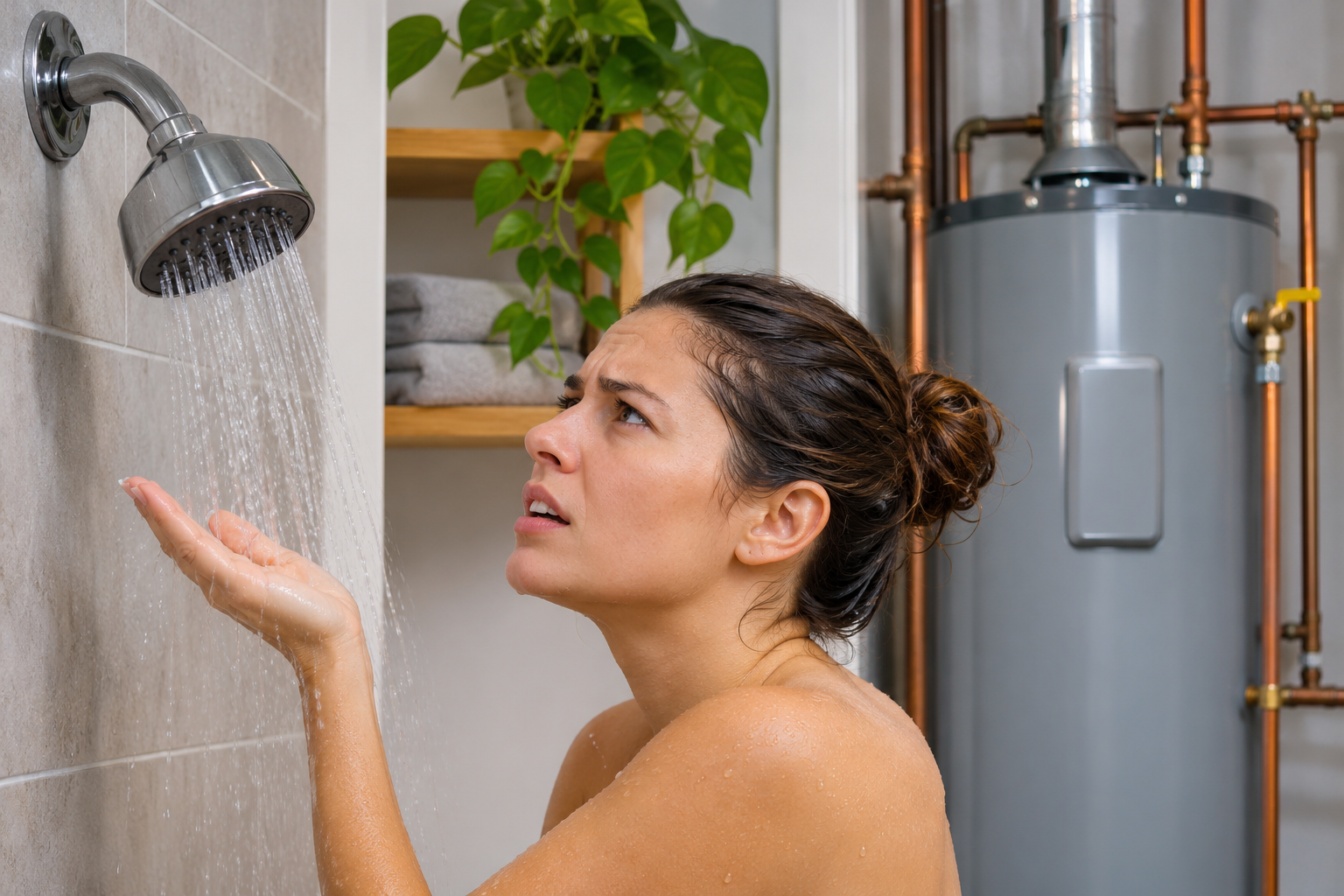
Few things are more frustrating than stepping into a hot shower only for the water to turn lukewarm a few minutes later. If your hot water runs out quickly, the problem may be as simple as unusually high household demand, or it may point to an issue inside your water heater.
A properly working water heater should supply enough hot water for the normal needs of the household it was selected for. When that supply suddenly becomes shorter, takes longer to recover, or no longer keeps up with everyday use, something has likely changed.
The cause could involve sediment inside the tank, a thermostat setting, a failing heating element, a damaged internal component, or a water heater that simply cannot keep up with the amount of hot water your household now uses.
Understanding what is happening can help you decide whether the solution involves a simple adjustment, professional water heater repair, or eventually replacing the system.
First, Is Your Water Heater Actually Running Out of Hot Water?
Before assuming the water heater is failing, pay attention to exactly what happens.
Does the water start very hot and gradually become cold?
Does it become lukewarm almost immediately?
Do you have plenty of hot water in the morning but not after several people shower?
Does the problem affect every faucet and shower, or only one fixture?
These details matter because they point toward different causes.
If every hot water fixture loses temperature after several minutes, the water heater itself becomes a likely place to investigate. If the problem occurs at only one shower or faucet, the issue could instead involve that fixture, its mixing valve, or nearby plumbing.
A plumber can inspect both the heater and the surrounding system when the source is unclear. Foukas Plumbing & Heating provides broader plumbing repair services when the problem is not limited to the water heater itself.
Your Household May Be Using Hot Water Faster Than the Tank Can Replace It
A traditional storage water heater does not provide an unlimited supply of hot water. It heats and stores a certain amount, then begins reheating incoming cold water as the stored hot water is used.
Imagine two people taking showers while the dishwasher and washing machine are also using hot water. Even a completely functional water heater can struggle to keep up with several fixtures operating close together.
The important measurement for a storage water heater is not simply the number printed on the tank. Its recovery ability also matters.
Water heaters have a first hour rating that describes how much hot water the system can provide during a period of heavy use when starting with a heated tank.
If your household has changed since the heater was installed, perhaps because more people now live in the home or hot water use has increased, the original system may no longer match current demand.
This becomes especially noticeable during mornings, evenings, holidays, or when guests are staying in the house.
Sediment Can Reduce the Useful Space Inside a Water Heater Tank
Tank water heaters can gradually collect minerals and sediment at the bottom of the tank.
Water enters the heater carrying naturally occurring minerals and other material. As water is repeatedly heated, some of that material can settle inside the tank.
Over time, significant buildup can interfere with normal water heater performance.
A tank that originally held enough usable hot water for the household may effectively have less useful capacity when sediment occupies space at the bottom. Buildup can also interfere with heat transfer depending on the type and design of the heater.
You might notice:
- Hot water running out sooner than it used to
- Longer recovery between showers
- Unusual sounds coming from the tank
- Reduced water heater performance
- Changes that developed gradually rather than suddenly
Sediment is only one possible cause, so these symptoms should not automatically be treated as proof of buildup.
Routine service and inspection of your water heater system can help identify what is actually affecting performance.
A Heating Element May Be Failing in an Electric Water Heater
Many electric storage water heaters use upper and lower heating elements.
When both elements are functioning correctly, they work together with the controls inside the heater to maintain the stored water at the selected temperature.
If one heating element fails, the heater may still produce hot water. That can make the problem confusing because the system does not appear completely broken.
Instead, you may notice that you have only a small amount of hot water before the temperature begins dropping.
For example, a household that previously had enough hot water for two consecutive showers may suddenly struggle to finish one. The heater still produces hot water, but its usable capacity and recovery performance no longer feel normal.
Testing an electric heating element involves electrical components and should be handled carefully. If the problem appears to involve the heater’s electrical system, professional diagnosis is safer than repeatedly resetting controls or opening electrical panels without the appropriate experience.
Thermostat Problems Can Affect Both Temperature and Recovery
A water heater thermostat controls when the system heats the water and when heating stops.
If the thermostat is set too low, the water stored in the tank may not be hot enough to provide the amount of usable hot water you expect.
A malfunctioning thermostat can create similar symptoms.
The situation can become more complicated on electric water heaters that have separate controls associated with their heating elements. A problem with one component may leave the heater operating partially rather than shutting down completely.
Avoid responding by simply turning the temperature much higher.
Higher storage temperatures can increase the risk of scalding, and temperature adjustments should account for the heater design, household occupants, manufacturer guidance, and any mixing valve installed in the system.
If the temperature has changed without anyone adjusting the heater, that is a stronger reason to have the controls inspected.
A Damaged Dip Tube Can Mix Cold Water Into the Hot Supply Too Soon
Inside many tank water heaters is a component commonly called a dip tube.
Its job is straightforward. Incoming cold water needs to enter near the lower portion of the tank while heated water is drawn from the upper portion.
When the dip tube is damaged, deteriorated, or no longer directing incoming water properly, cold water can mix with the hot water higher in the tank.
The result can feel like the heater is running out of hot water unusually fast.
You may start with properly heated water, but the temperature falls sooner than expected because cold incoming water is mixing into the usable hot water supply.
A dip tube is hidden inside the system, so homeowners usually cannot confirm this problem just by looking at the outside of the tank. A plumber can determine whether the symptoms point toward the dip tube or another internal component.
Your Water Heater May Simply Be Too Small for the Home
Sometimes nothing is mechanically wrong.
The water heater may simply be undersized for the amount of hot water being used.
Household size alone does not tell the whole story. Two homes with the same number of occupants can have very different hot water requirements.
One household may take short showers at different times of day. Another may regularly use several showers, laundry, kitchen fixtures, and a dishwasher during the same period.
That is why proper water heater installation involves more than choosing a tank based only on its gallon capacity.
The installer should consider household demand, available fuel or electrical service, recovery requirements, available space, and the type of water heater being installed.
If your current heater has always struggled with consecutive showers, the problem may have been sizing rather than a recent mechanical failure.
Why Does My Hot Water Run Out Faster Than It Used To?
A sudden change deserves more attention than a water heater that has always had limited capacity.
If you previously had enough hot water and now run out much sooner, something has probably changed.
Possible explanations include:
- A failed electric heating element
- Thermostat or control problems
- Sediment accumulation
- A damaged dip tube
- Increased household hot water use
- Plumbing leaks
- Changes in water heater operating settings
- Performance problems developing as the unit ages
One useful question is whether the change happened suddenly or gradually.
A sudden loss of capacity may point toward a failed component or control problem. A slow decline may be more consistent with sediment accumulation, equipment wear, or gradually increasing household demand.
That distinction does not provide a complete diagnosis, but it gives a plumber useful information when troubleshooting the system.
Why Does Hot Water Run Out Quickly During a Shower?
Showers often make water heater problems noticeable first because they require a continuous supply of heated water.
The shower mixes hot and cold water to reach a comfortable temperature. As hot water leaves a storage tank, cold water enters the heater to replace it.
Eventually, the amount of newly introduced cold water can exceed the heater’s ability to maintain the desired supply temperature.
That is normal once the available hot water has been used. The concern is when it begins happening much sooner than it previously did.
Check Whether Other Appliances Are Using Hot Water
Before assuming the shower itself is responsible, consider what else is operating.
Someone may have recently used another shower, filled a bathtub, run the dishwasher, or completed laundry.
Those uses can significantly reduce the hot water available for the next person.
Consider Whether the Shower Is the Only Problem
If every faucet has plenty of hot water but one shower becomes cold quickly, the water heater may not be the problem.
A shower valve or cartridge can affect the balance of hot and cold water.
When symptoms appear at only one fixture, investigating that fixture first can prevent unnecessary water heater work.
Tankless Water Heaters Can Have Hot Water Limitations Too
A common misconception is that tankless means unlimited hot water under every condition.
A tankless water heater heats water as it flows through the unit instead of storing a large tank of preheated water.
That removes the fixed tank capacity limitation, but the heater still has a maximum flow capacity.
Imagine a tankless system that handles one shower comfortably. If several showers and hot water appliances begin operating at the same time, the combined demand may exceed what that unit can heat to the requested temperature.
When evaluating a tankless water heater, flow rate and required temperature rise are important.
A system needs to be selected according to the actual hot water demand of the home rather than simply assuming that any tankless model will provide unlimited hot water everywhere at once.
If a tankless unit that previously worked well suddenly begins struggling, mineral buildup, maintenance issues, controls, flow sensors, or other system problems may need inspection.
Heat Pump Water Heaters Behave Differently During Heavy Demand
A heat pump water heater moves heat from surrounding air into the stored water.
Many models can also use electric resistance heating when additional heating capacity is needed.
Operating mode matters.
Some heat pump water heaters offer settings designed to favor energy savings, while other modes allow additional heating support during periods of high hot water demand.
A household may notice slower recovery if the heater is operating in a mode that prioritizes heat pump operation while hot water use is unusually heavy.
Tank sizing also matters. A heat pump water heater selected for normal household use should account for periods when several occupants need hot water within a relatively short time.
Before changing operating modes or settings, check the manufacturer’s instructions for the specific unit.
Hidden Plumbing Problems Can Make Hot Water Disappear Faster
Not every hot water shortage begins inside the water heater.
A leaking hot water pipe or fixture can continuously remove heated water from the system. The heater then has to replace and heat that lost water even though nobody intentionally used it.
Some leaks are obvious. Others are hidden behind walls, below floors, or near plumbing fixtures where they are harder to notice.
Signs that deserve further investigation include unexplained water around the heater, dripping fixtures, unusual sounds, moisture damage, or changes in water use.
There can also be problems involving plumbing connections or mixing between hot and cold water lines.
If the water heater appears to operate normally but the hot water supply still behaves strangely throughout the house, broader residential plumbing services may be needed to trace the source.
When Repair Makes More Sense Than Replacement
Running out of hot water does not automatically mean you need a new heater.
If the tank itself remains in suitable condition and the problem involves a replaceable component, repairing the existing unit may be reasonable.
Examples can include certain thermostat, heating element, control, valve, or component problems.
The right decision depends on what has failed, the condition of the rest of the system, repair feasibility, equipment age, and whether the current water heater still meets the household’s needs.
Replacement deserves more consideration when the system has recurring problems, significant deterioration, leakage from the tank itself, or insufficient capacity that cannot realistically meet household demand.
A professional evaluation should separate a repairable performance problem from a heater that no longer makes practical sense to keep.
If replacement becomes the better option, water heater replacement also creates an opportunity to reconsider capacity and water heater type rather than automatically installing an identical system.
Choosing a Better Water Heater for Your Actual Hot Water Needs
If your existing heater cannot keep up even when it is operating correctly, replacement should focus on the way your household actually uses hot water.
Consider questions such as:
How many showers commonly happen close together?
Are laundry and dishwashing usually happening at the same time?
Has the number of people in the home changed?
Do you frequently fill a large bathtub?
Is your current heater struggling only occasionally or almost every day?
Would a storage, tankless, or heat pump system better fit your home?
For storage water heaters, useful capacity and first hour performance matter. Tankless systems should be evaluated according to simultaneous flow demand. Heat pump units require proper tank sizing and operating considerations.
There is no single water heater type or size that is automatically right for every household.
The best choice is the one that can reliably meet realistic demand while fitting the home’s plumbing, energy source, installation requirements, available space, and budget.
When It Is Time to Have the Water Heater Checked
A single cold shower after unusually heavy hot water use may not indicate a problem.
Repeated shortages are different.
Consider scheduling an inspection when:
- Your hot water supply has noticeably decreased
- The heater takes much longer to recover
- Water never becomes as hot as it once did
- You hear unusual noises from the tank
- Hot water temperature changes unpredictably
- The heater is leaking
- Breakers or controls repeatedly need resetting
- Your household regularly runs out of hot water despite normal use
Avoid opening electrical compartments, working on gas components, disabling safety devices, or making major temperature adjustments without understanding the equipment.
Water heaters combine hot water with electricity, gas, combustion equipment, or pressurized plumbing depending on the system. Some troubleshooting is better left to someone trained to work with those components safely.
Get to the Cause of Your Hot Water Problem
When hot water runs out quickly, the goal should not be to guess which part needs replacing. The symptoms need to be connected to the actual cause.
Sometimes the explanation is simply heavy simultaneous water use. In other situations, sediment, a heating element, thermostat, dip tube, plumbing problem, or incorrectly sized water heater may be responsible.
Foukas Plumbing & Heating can inspect the system, identify what is affecting hot water availability, and determine whether repair or replacement makes sense for the home.
If your water heater no longer provides enough hot water for normal household use, contact Foukas Plumbing & Heating to have the problem evaluated.