


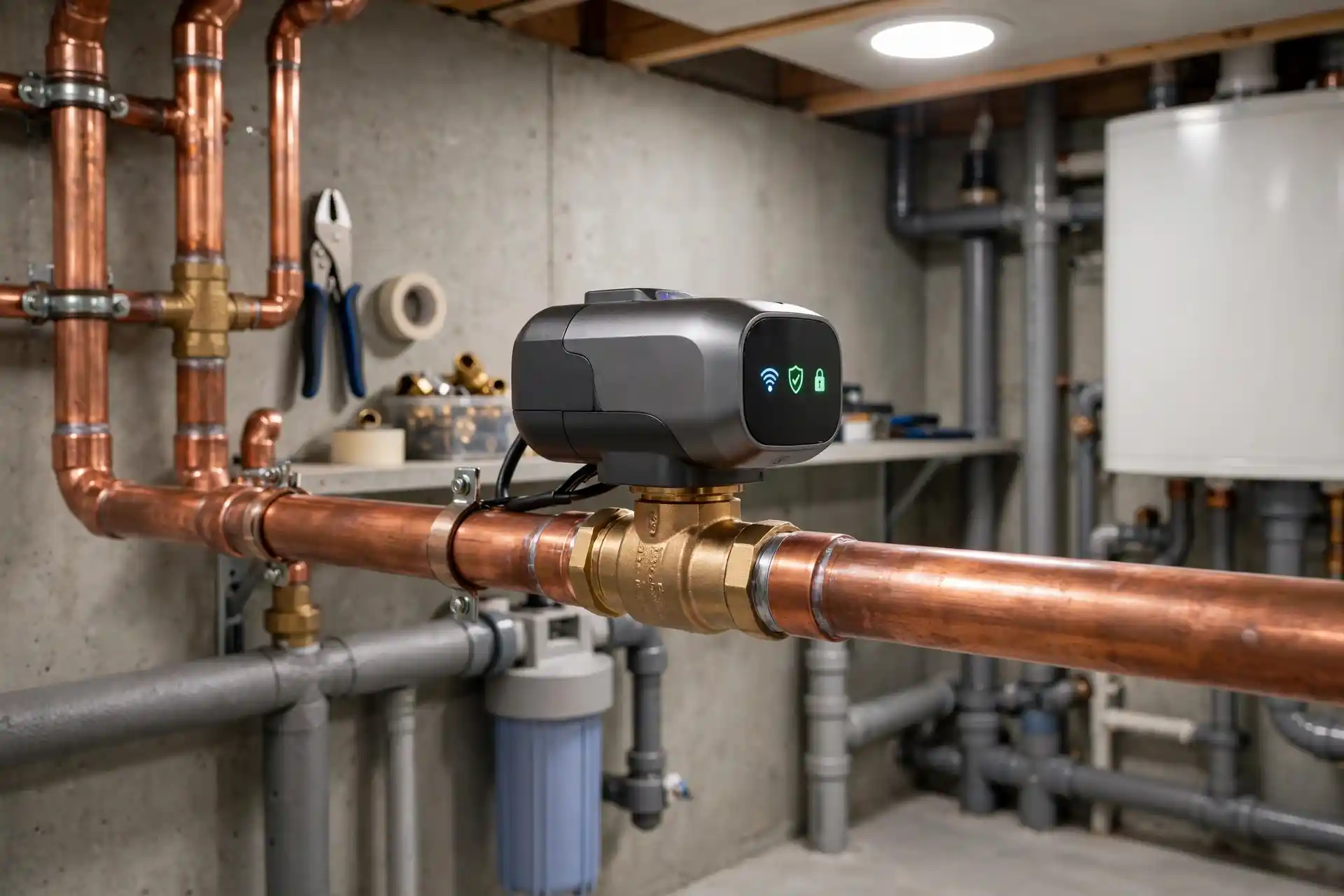
A whole-home water shut-off system is a motorized valve installed on your main water line that turns off your home’s water automatically when it detects a leak or abnormal flow. It pairs that valve with either flow monitoring that learns your household’s usage patterns or wireless sensors placed near high-risk appliances, and it alerts your phone the moment it acts.
Plumbers sometimes call it a smoke detector for water. The analogy holds up well. Like a smoke detector, it watches constantly, needs no one to operate it, and earns its keep in the rare moment everything goes wrong. Unlike a smoke detector, it doesn’t just warn you. It stops the problem.
Picture the scenario it exists for. You come home from a long weekend and find water running down the basement stairs. A supply line behind the washing machine split while you were gone, and your plumbing has been pouring water into the house at full pressure ever since. By the time you notice, soaked drywall, ruined flooring, and a five-figure repair bill are already locked in.
Your house had a main water valve the whole time. It just couldn’t turn itself off.
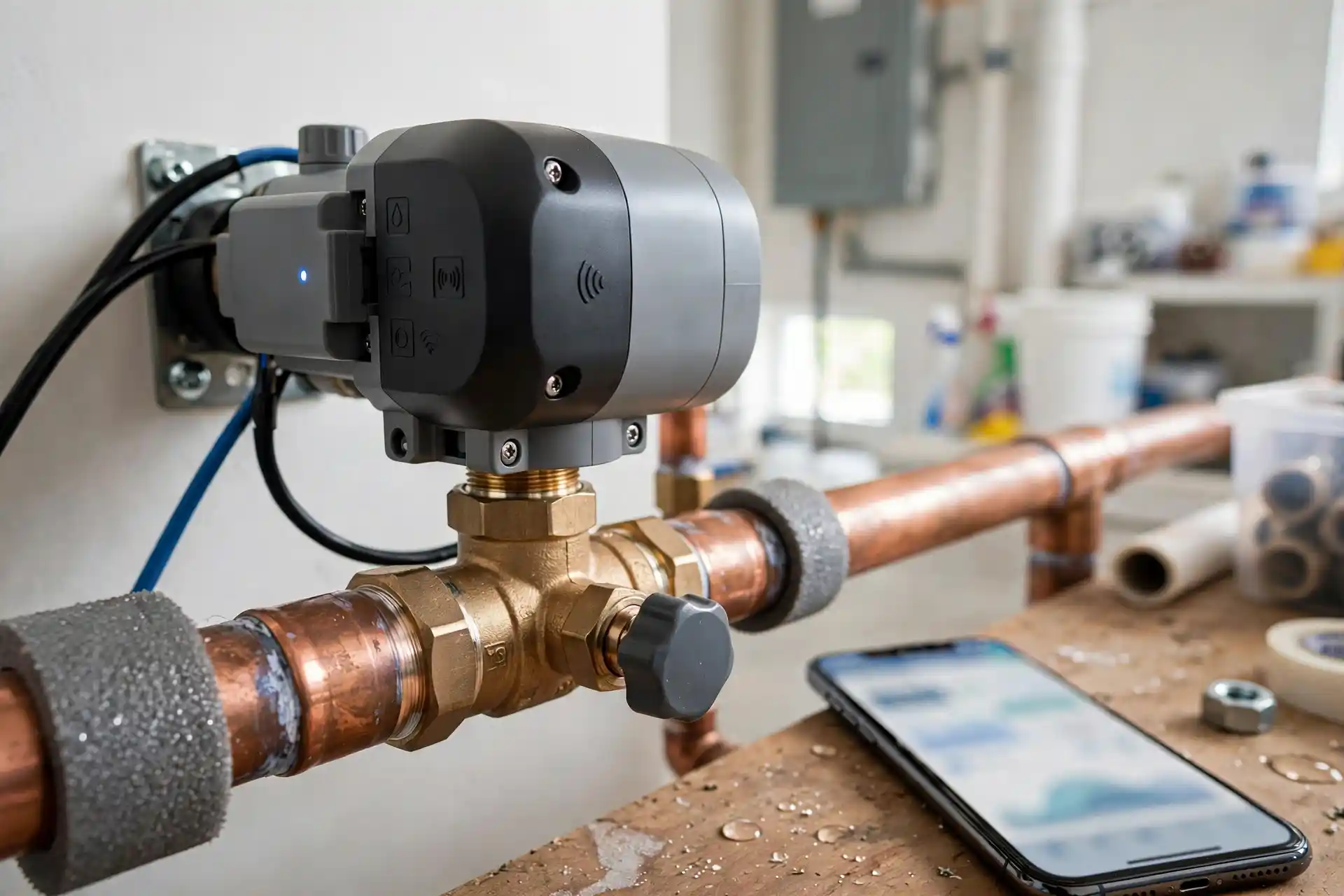
How It Works in Three Steps
Every system on the market, from the simplest sensor kit to the most advanced flow monitor, follows the same three-step sequence:
1. Detect. The system watches for trouble using one of two methods. Flow-based systems monitor water moving through your main line around the clock, looking for patterns that don’t match your household’s normal usage. Sensor-based systems use small wireless pucks placed under sinks, behind toilets, and around appliances; when water touches one, it signals an alarm.
2. Decide. Detection alone isn’t action. The system’s controller evaluates what it sees against its thresholds. A flow-based unit checks whether the anomaly fits a leak profile or just looks like someone running the garden hose. A sensor-based unit has a simpler decision: water where it shouldn’t be means act now.
3. Shut off and alert. The motorized valve on your main line closes, stopping water to the whole house, often within seconds. Simultaneously, the system sends an alert to your phone telling you what happened and where. Once the problem is fixed, you reopen the valve through the app or by hand.
What the System Is Watching For
The specific triggers vary by system, but they cluster around four patterns. Continuous flow beyond a set duration, like a toilet fill valve stuck open all night. Sudden high flow that looks like a burst pipe. Pressure anomalies that suggest pinhole leaks developing inside walls. And freezing temperatures near pipes, which several systems monitor as an early warning before ice can form and split a line.
Some advanced units also run scheduled health checks, briefly closing the valve in the middle of the night to see whether the system holds pressure. A pressure drop during that quiet test reveals micro-leaks too small for any other method to catch, including the slow drips that silently inflate water bills for months.
The Two Types of Systems, Compared
Nearly every product falls into one of two designs, and understanding the difference matters because insurers, installers, and manufacturers all treat them differently.
|
Flow-Based System |
Sensor-Based System |
|
|---|---|---|
|
How it detects trouble |
Analyzes flow and pressure at the main line |
Spot sensors detect standing water at specific locations |
|
Installation |
Plumber cuts into the main line; needs power and Wi-Fi nearby |
Valve on the main line; sensors placed by hand |
|
Catches hidden leaks |
Yes, including pinhole leaks and slow drips inside walls |
No, only where sensors sit |
|
Response speed |
Seconds to minutes, depending on the anomaly |
Seconds, once water reaches a sensor |
|
Learning period |
Usually one to two weeks of normal use |
None |
|
Insurance recognition |
Strongest; most carrier discounts require this type |
Weaker; alert-only setups rarely qualify |
|
Best for |
Whole-house coverage, frequent travelers, second homes |
Targeted protection, tighter budgets |
The two approaches also combine well. A flow-based valve on the main line gives you whole-house coverage and hidden-leak detection, while a few spot sensors at the water heater and washing machine add faster response where failures are most likely. Many homeowners end up with this hybrid setup.
Choose Flow-Based If…
- You travel frequently or own a second home, since away mode tightens protection when the house is empty
- Your home has a finished basement, expensive flooring, or valuables that would be costly to restore
- Your plumbing is older and you’re worried about the slow deterioration you can’t see
- Your insurance carrier offers a meaningful discount, since most require an inline automatic valve to qualify
Choose Sensor-Based If…
- Your main concern is specific appliances, like an aging water heater or an old washing machine
- You want protection at a lower entry price and can place sensors thoughtfully
- Your home is smaller, with all water-using appliances within a few rooms
- You’re building toward a full system and want to start with the highest-risk spots first
Why Your Existing Main Valve Won’t Save You
Every home already has a manual whole-house shut-off valve, usually where the water line enters the building. It’s essential for plumbing work. As emergency protection, though, it has three weaknesses that matter.
First, the valve itself. Older Massachusetts homes often have a gate valve with a round wheel handle that takes multiple turns to close. After years of sitting open, gate valves corrode and seize. Discovering yours won’t budge while water is spreading across the floor is a bad moment to learn this.
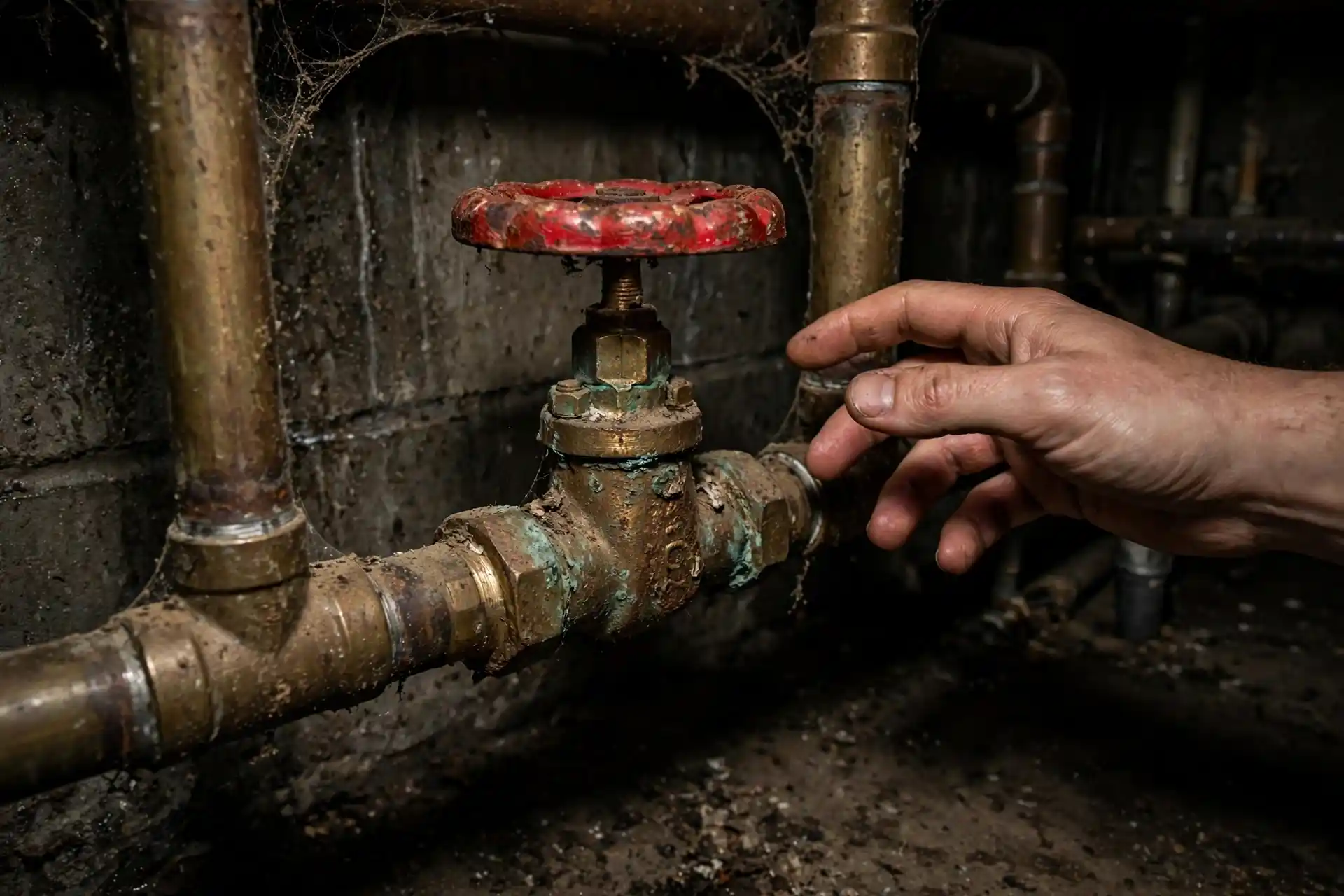
Second, access. Main valves hide behind stored boxes, inside cramped crawl spaces, or out at buried meter pits. Fine for a planned repair on a Saturday morning. Not fine at midnight with water pooling around your feet.
Third, and most decisively, a manual valve needs a person. Supply lines fail while you’re at the office. Water heaters rupture on vacation. Pipes freeze during the February cold snap when the whole street is dealing with the same weather. If nobody is home to turn the valve, water runs until someone notices.
An automatic system removes the person from that equation. It also creates a useful side effect: installation forces attention onto that old valve. Most plumbers will assess it during the job and recommend professional plumbing repairs or an upgrade if it’s seized or corroded.
Why Water Damage Gets Expensive So Quickly
The burst pipe is only the beginning. What destroys a home is everything after: hours or days of water spreading through flooring, wicking up drywall, soaking insulation, and feeding mold growth inside walls where you can’t see it. The Insurance Information Institute has reported that roughly one in 60 insured homes files a water damage or freezing claim, making it one of the most common property claims in the country.
Damage severity is almost entirely a function of time. A leak caught in five minutes is a cleanup job. The same leak running for two days is a reconstruction project with mold remediation on top. Industry sources commonly put the average claim in the mid five figures, and catastrophic events involving structural damage and mold climb far higher.
That time relationship explains why detection alone often falls short. A sensor that texts you about a leak while you’re three states away is helpful, but the water keeps flowing until someone physically closes a valve. If a rapid response is ever needed, emergency plumbing exists for exactly that reason, but even the fastest plumber can’t undo the water that already escaped.
What These Systems Stop, and What They Can’t
Honest expectations matter more than hype, so here are the boundaries, stated plainly.
A whole-home shut-off system stops pressurized plumbing failures: burst pipes, split supply lines, failed washing machine hoses, ruptured water heater tanks, leaking toilet fill valves, ice maker line failures, and frozen pipes that burst on thawing. In every one of these, water flows under pressure from your supply system, and closing the main valve stops the damage from growing.
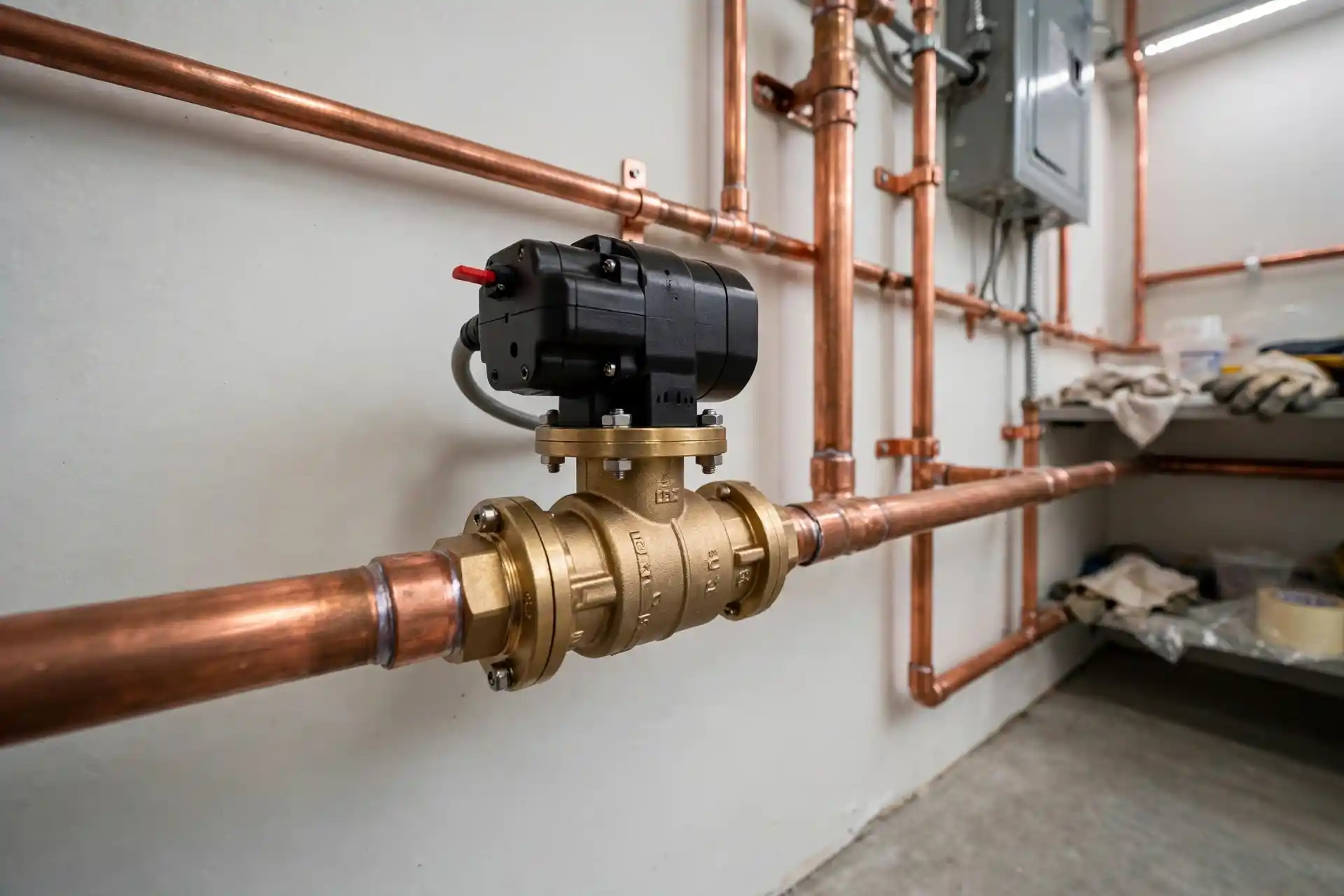
What it can’t stop is equally important, and this is where some marketing gets quiet. Drain and sewer backups flow the other direction; shutting off your supply won’t help a backed-up sewer line. Roof leaks, groundwater seeping through foundation walls, and storm flooding are entirely outside the system’s reach. Water already sitting in the pipes will still drain out after shutoff, though that’s a small volume next to what a pressurized line delivers. And any plumbing upstream of the valve, like an outdoor spigot teed off before the installation point, isn’t protected.
None of that diminishes the value. It just frames the system correctly: one strong layer of protection, not a magic shield. For leaks no device has caught yet, dedicated leak detection services using professional acoustic and thermal equipment can find what consumer sensors miss.
False Alarms and How Systems Avoid Them
This is the concern almost every homeowner raises, and most articles dodge it. Let’s not.
Yes, automatic shut-offs can trigger when nothing is actually wrong. The classic stories: the valve closes mid-shower because someone ran an unusually long one, or a house full of guests drives water usage so far above normal that the system assumes the worst. One plumber’s site even describes systems with a warning window, giving you a few minutes to cancel a shutoff from your phone before it happens. That feature exists precisely because false positives are a known issue.

Manufacturers have spent years shrinking this problem. The learning period builds a usage profile specific to your household, so a family of five gets different thresholds than a retired couple. Most systems let you adjust sensitivity or set schedules, and installers configure the valve placement and settings around known quirks like irrigation systems, which are the most common false-alarm source. If your plumber knows about your sprinklers, pool autofill, or whole-house humidifier before installation, those get accounted for.
The practical takeaway: false alarms are mostly a setup problem, not a product flaw. A system configured for your actual home, with its actual water habits, rarely surprises you. A system installed without that conversation will.
The Insurance Angle: Discounts, Requirements, and Paperwork
Here’s where the topic gets financially interesting, and where the research turned up the sharpest distinctions.
Many homeowners insurance carriers offer premium discounts for automatic water shut-off systems, commonly cited in the 5 to 15 percent range, or roughly $100 to $500 a year depending on the premium. The logic is simple from the carrier’s side: these devices cut claim severity dramatically, and a discount costs less than a flooded basement.
But there’s a catch most articles gloss over. According to insurance-focused sources, only inline whole-house valves with automatic shutoff qualify for most carrier discounts. A set of sensor pucks that merely sends phone alerts, with no valve to stop the water, generally doesn’t earn the credit. The carrier is rewarding the system that acts on its own, not the one that asks you to act.
The trend is moving further. Some insurers have begun requiring leak detection devices for policy renewal in certain states, particularly for high-value homes. What started as an optional discount is becoming, in some corners of the market, an expectation.
If you want the discount, the process typically runs in three steps. First, install a device your carrier recognizes, which is why calling your agent before buying matters more than any product review. Second, notify your insurer after installation. Third, furnish proof: the installation invoice plus a certification letter from the licensed plumber, on company letterhead, confirming what was installed and where. Plumbers who do this work regularly know exactly what documentation carriers ask for, so mention the insurance angle when you book.
Run the math on your own policy. A $700 installed system against a $1,500 annual premium with a 10 percent discount pays for itself in under five years, even if it never detects a single leak. If it stops one burst pipe while you’re away, it pays for itself many times over in a single afternoon.
Why Massachusetts Homes Are Strong Candidates
These systems make sense anywhere, but Massachusetts homes carry a combination of risks that makes the case unusually strong.
First, the winters. Extended sub-freezing stretches are normal in New England, and the cruel part of a freeze isn’t the ice, it’s the thaw. A pipe freezes overnight, splits, and releases a full-pressure flood when temperatures rise and nobody’s watching. Many systems include temperature monitoring that warns you before pipes reach freezing conditions, which earns its keep here every January.

Second, the housing stock. Massachusetts has some of the oldest homes in the country, and older plumbing means older valves, corroded supply lines, and decades of repairs layered together. If your home still has its original gate-style main valve, there’s a real chance it won’t close when you need it. Installation is the natural moment to address that, often by replacing outdated plumbing components alongside the new system.
Third, the vacation pattern. Plenty of Massachusetts homeowners leave for extended winter trips or keep second properties. An empty house in January with a system in away mode is a fundamentally different risk profile than the same house with a manual valve and hope.
Our home plumbing services guide covers the seasonal maintenance habits that pair well with a system like this, including the winterizing steps that matter most in New England.
What Installation Actually Involves
Despite the smart technology, this is a straightforward plumbing job for a licensed professional, and it typically unfolds in three phases.
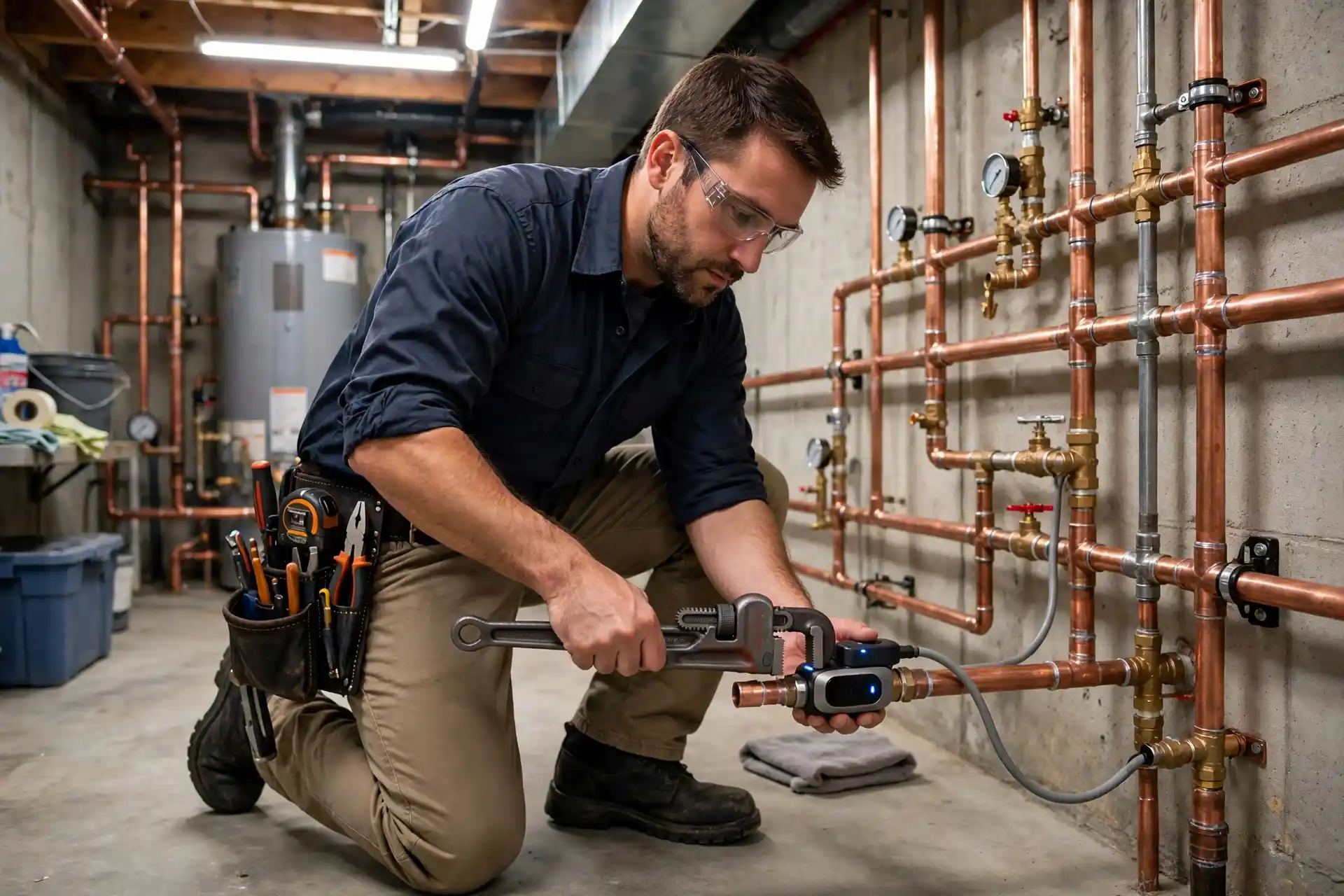
Before. The plumber assesses your main water line: its diameter (most residential systems fit standard 3/4-inch or 1-inch lines), the condition of your existing main valve, and where the new valve will go. Common locations include a utility or mechanical room, near the water heater, or in a basement or crawl space close to where the line enters. Slab homes may place it along the foundation wall. The plumber also confirms power and Wi-Fi reach the spot, since the valve needs electricity and a network connection for alerts and remote control.
During. Water gets shut off at the street or meter. The plumber cuts a section out of the main line, installs the motorized valve with professional-grade fittings, mounts and powers the unit, connects it to Wi-Fi, and pairs the app. Your water is off only during the pipe work itself, usually a few hours total.
After. Flow-based systems begin a learning period of a week or two. The plumber walks you through the app, tests a shutoff, and shows everyone in the household the manual override. That override matters: every reputable system lets you open or close the valve by hand if power or Wi-Fi ever fails.
Three things worth settling beforehand. First, professional installation is required by most manufacturers to honor the warranty, and insurers asking for proof expect a licensed plumber’s documentation. A professional plumbing installation also ensures the valve is sized correctly so it doesn’t choke your home’s water pressure. Second, ask about battery backup, since Massachusetts storms knock out power regularly and the system should keep working through an outage. Third, if the device carries certifications like NSF/ANSI 61-G for lead-free materials or UL listing, that’s a meaningful quality signal; not all units have them.
Renters and condo owners have a narrower path. Cutting into the main line isn’t an option in a rental, but retrofit actuators that clamp onto an existing accessible ball valve, paired with wireless sensors, install without modifying plumbing and come off when you move. If you’re unsure what your building allows, ask before buying anything.
The plumber will also want to know about your main water line configuration, including any irrigation or sprinkler lines, since those get routed or configured around the new valve.
What It Really Costs
Costs vary enough that a single figure would mislead, so here’s the honest breakdown.
The device itself runs from roughly $150 for basic sensor-based kits to $700 or more for full flow-based systems with advanced monitoring. Professional installation commonly adds $150 to several hundred dollars, depending on access to your main line, pipe material, and local labor rates. Most homeowners land between about $400 and $1,000 all in for a standard setup, with complex installations running higher.
The smaller ongoing costs are worth knowing. Extra sensors beyond the included set run about $20 to $50 each. Sensor batteries need replacing every few years, maybe $10 to $20 a year for a typical home. Some systems offer optional subscriptions for extended data history, but core protection works without a monthly fee on most.
If the full system isn’t in the budget right now, there’s a sensible staged path: start with a good set of leak sensors in the highest-risk spots, choosing ones compatible with a shutoff valve you might add later, then add the valve when budget allows. You improve protection immediately and spread the cost.
For an accurate figure based on your home’s layout and main line, contact our team for a quote. Every house is a little different, and a quick assessment is the only way to price yours correctly.
Questions Homeowners Ask Before Installing
Will it catch a slow leak inside a wall?
A flow-based system can, through pressure monitoring and scheduled pressure tests that reveal micro-leaks during quiet hours. Spot sensors cannot; they only catch water that reaches them. This is the single biggest capability gap between the two designs, and it’s why hidden-leak protection points toward flow-based monitoring.
What happens during a power outage?
Most systems include battery backup that keeps detection and shutoff working for hours to days, and every reputable unit has a manual override so you can operate the valve by hand. Confirm the backup runtime before you buy, especially if your area loses power in storms.
Does it need Wi-Fi to protect my home?
The core job, detecting a leak and closing the valve, runs locally on most systems and doesn’t depend on your internet. Wi-Fi powers the app features: remote alerts, remote shutoff from your phone, and usage reports. If your Wi-Fi drops, the valve still does its job; you just won’t get the push notification until you’re home.
Can it tell a leak from my teenager’s long shower?
Usually, yes, after the learning period builds your household’s profile. Most systems also warn you before shutting off, giving you a chance to cancel from the app. The false alarms that do happen tend to trace back to setup: irrigation, pool equipment, or a new appliance the system wasn’t told about.
What maintenance does it need?
Test the valve monthly through the app to keep it cycling freely. Replace sensor batteries when flagged. Update firmware when prompted, since manufacturers refine detection algorithms over time. Before vacations, enable away mode. Before winter, confirm freeze alerts are set. None of this takes more than a few minutes.
How do I choose the right system for my house?
Start from your risks, not the product catalog. Frequent traveler with an older home and a finished basement? Flow-based, professionally installed. Focused on one aging appliance and watching the budget? Sensors plus a valve on a staged plan. Unsure? A plumber’s assessment of your main line, valve condition, and layout answers it faster than any review. Our residential plumbing services page explains what that assessment covers, and our full plumbing services lineup shows where a shut-off system fits into a broader protection strategy.
A whole-home water shut-off system won’t stop every kind of water damage, and no honest plumber would claim otherwise. What it does is remove the most dangerous variable in the equation: time. Start by locating your main valve today. Try turning it. If it won’t budge, that’s already useful information.
If you’re in our service areas, we’d be glad to assess your main line, walk you through the options, and give you a straight answer on cost. You can reach us here to schedule that conversation. Your home’s plumbing works hardest when nobody’s watching. It’s worth having something watching back.