


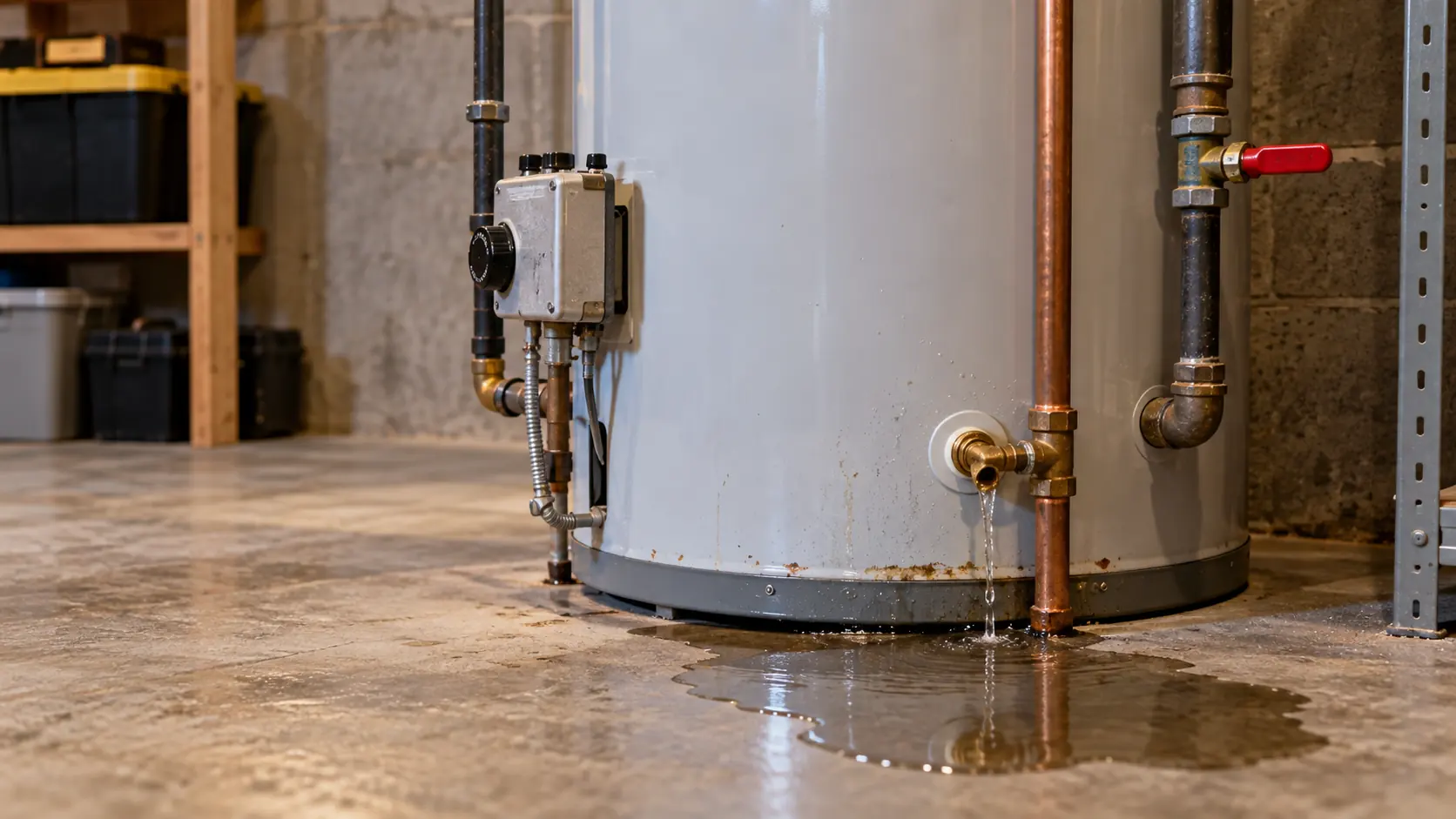
Finding water around your water heater can be concerning, especially when you cannot tell where it is coming from. Sometimes the problem is a loose plumbing connection or a faulty valve. Other times, water collecting beneath the unit may indicate corrosion inside the storage tank.
A water heater can leak because of damaged fittings, excessive water pressure, a faulty drain valve, a malfunctioning temperature and pressure relief valve, or deterioration of the tank itself. The location of the water often provides the first clue, but a puddle beneath the heater does not automatically mean the tank needs replacing.
Understanding the possible causes can help you prevent further water damage and determine whether the problem requires a simple repair or a new water heater.
The most important thing is to address the leak safely before trying to identify its source.
What Should You Do First When Your Water Heater Is Leaking?
Before investigating a leaking water heater, consider the risks associated with electricity, gas, hot water, and pressurized plumbing.
Even a small leak deserves attention because water can damage flooring, walls, electrical components, and nearby belongings.
If you smell gas, leave the building immediately. Do not operate electrical switches, attempt to shut off gas equipment, or investigate the source. Call 911 or your gas utility from outside.
For a water leak without signs of a gas emergency, follow these precautions.
- Turn off the heater’s energy supply if it is safe to do so. For an electric water heater, switch off the appropriate circuit breaker from a dry, accessible location. For a gas water heater, follow the manufacturer’s shutdown instructions if the controls are safely accessible. Never approach electrical equipment through standing water.
- Shut off the cold water supply. Locate the cold water inlet valve supplying the heater and close it if accessible. This can help limit additional water entering the tank. If the valve cannot be reached safely or does not work, the property’s main water shutoff may be necessary.
- Avoid contact with leaking hot water. Water released from the tank or safety valve may be hot enough to cause burns. Do not open drain valves or disconnect pipes.
- Observe where the water is appearing. If the area is safe, look for moisture around the top fittings, side valves, drain connection, and bottom of the heater. Photographs may help a plumber identify the problem.
- Arrange a professional inspection. A plumber can determine whether the issue involves a replaceable component, excessive pressure, or damage to the tank.
If the leak is spreading rapidly or cannot be controlled, professional emergency plumbing services can help address the immediate problem.
Do not restart a water heater after shutting off its water supply until the problem has been corrected and the unit has been properly refilled according to the manufacturer’s instructions.
Is Your Water Heater Actually Leaking or Is It Condensation?
Not every puddle around a water heater comes from a damaged tank.
Condensation can develop when moisture in the air encounters a cold surface. This is particularly noticeable around cold water pipes in humid environments.
Gas storage water heaters may also produce temporary condensation when cold incoming water cools internal surfaces during heating. Moisture can collect and drip near the bottom of the appliance.
Condensation generally decreases as the equipment warms up. A persistent puddle, repeated moisture accumulation, or visible water flowing from a fitting requires further investigation.
How Condensation Differs From a Plumbing Leak
Condensation often appears as light moisture spread across a cooler surface rather than water escaping from one specific point.
A plumbing leak is more likely to produce recurring droplets at a connection, visible dripping from a valve, or water that continues accumulating.
However, these observations are not conclusive. Condensation and leaks can occur at the same time.
If the water keeps returning or the source remains uncertain, professional leak detection services can help distinguish a plumbing failure from moisture produced during normal equipment operation.
What Causes a Water Heater to Start Leaking?
Water heaters contain several connections and components that can deteriorate or develop problems.
The most common causes involve fittings, valves, water pressure, and tank condition.
Loose or Corroded Plumbing Connections
The cold water inlet and hot water outlet are connected to the home’s plumbing system. These connections can develop leaks because of aging seals, corrosion, damaged fittings, or repeated changes in temperature.
When water escapes from a connection near the top of the heater, it may travel down the outer casing before reaching the floor.
This can create the appearance of a tank leak even when the problem is limited to a plumbing fitting.
A plumber may be able to reseal or replace the affected connection without replacing the heater.
If the problem extends into the building’s supply piping, water line services may also be needed.
A Faulty Drain Valve
Storage water heaters normally have a drain valve near the bottom of the tank.
This valve provides access for draining the unit during certain maintenance procedures. Over time, its seals can deteriorate, or the valve may fail to close properly.
A leaking drain valve can produce anything from occasional droplets to a steady stream of water.
If the leak is coming directly from the valve outlet or its connection, the valve may need professional replacement.
Attempting to remove or force an aging valve can make the problem worse and may release hot water.
Excessive Water Pressure
Water heaters are designed to operate within specified pressure limits.
When water pressure becomes excessive, it places additional stress on plumbing connections, valves, and the storage tank.
Pressure can also rise as water heats and expands, particularly in a closed plumbing system where expanded water cannot move backward into the supply.
This process is called thermal expansion.
Depending on the plumbing configuration, a properly sized expansion tank or pressure reducing valve may be needed.
A plumber should measure the system pressure and identify the cause before recommending either component.
Worn Heating Element Gaskets
Electric storage water heaters use heating elements installed through openings in the tank.
Seals or gaskets around these elements help prevent water from escaping.
When a gasket deteriorates, moisture may appear around the element’s access area.
This type of leak can sometimes be repaired by replacing the gasket or correcting the connection. Because the affected area contains electrical components, inspection and repair should be handled by a qualified professional.
Corrosion Inside the Storage Tank
Many traditional storage water heaters use a protected steel tank that can gradually deteriorate.
The protective lining and anode rod help limit corrosion, but they cannot prevent every form of deterioration indefinitely.
As a tank ages, internal corrosion may eventually create an opening through which water escapes.
When the tank body itself has developed a leak, replacing an external valve or fitting will not solve the problem.
Professional water heater repair services can help confirm the source before a homeowner spends money on an unnecessary replacement.
Why Is My Water Heater Leaking From the Top?
Water appearing near the top of a storage water heater often points toward a connection problem.
The hot water outlet and cold water inlet are common places to inspect visually. Other possible sources include the anode rod fitting, nearby piping, and connections associated with installed accessories.
If moisture is visible around a threaded fitting, the problem may involve the seal or the fitting itself.
Corrosion around a connection can also indicate that moisture has been present for some time.
However, water near the top does not always mean the tank’s connection is responsible. A pipe located above the heater may be dripping onto it.
A plumber will generally trace the moisture to its highest visible point and examine the surrounding connections before recommending repairs.
This distinction matters because replacing a damaged fitting is very different from replacing a failed storage tank.
Why Is My Water Heater Leaking From the Bottom?
A water heater leaking from the bottom can have several explanations.
A damaged drain valve is one possibility. Water may also run down the outside of the unit from a higher connection and accumulate underneath it.
A temperature and pressure relief valve discharge pipe can also release water near floor level, making the problem appear to originate from the base.
Condensation is another possibility, particularly with certain gas water heaters during heating.
The more serious concern is an internal tank leak.
When corrosion creates an opening in the storage tank, water may escape through the bottom or appear around the outer jacket.
Signs That May Point Toward Tank Failure
Rust staining around the base, moisture emerging from beneath the tank jacket, and persistent leaking after external connections have been ruled out can indicate internal deterioration.
These symptoms should be evaluated together rather than treated as proof of a failed tank.
For example, water dripping from a top connection can follow the tank’s surface and leave rust colored stains near the floor.
If an inspection confirms that the storage tank itself is leaking, water heater replacement is normally necessary.
A corroded pressure vessel should not be patched with household sealants or temporary repair products.
Why Is Water Coming From the Pressure Relief Valve?
Most storage water heaters have a temperature and pressure relief valve, commonly called a T&P valve.
This component is an important safety device.
Its purpose is to release water when the pressure or temperature inside the tank exceeds the valve’s specified operating limits.
The valve normally connects to a discharge pipe that directs released water toward an appropriate termination point.
If water is dripping from the end of this pipe, the valve may be opening because of excessive pressure, high temperature, or a problem with the valve itself.
Why the Valve May Drip When Water Heats Up
Water expands as its temperature rises.
In a closed plumbing system, this expansion can increase pressure if the system lacks an effective method of managing it.
A T&P valve may release small amounts of water as pressure builds.
Repeated dripping can indicate a thermal expansion issue, excessive incoming water pressure, or a faulty valve.
A sudden discharge of very hot water may signal a more serious temperature or pressure problem.
Never plug, cap, obstruct, or remove the discharge pipe to stop a leaking relief valve. Doing so can interfere with an essential safety function.
A plumber should determine why the valve is releasing water rather than simply replacing it without investigating the underlying conditions.
Why Does My Water Heater Leak Only When It Is Heating?
Some water heater leaks appear only during or shortly after a heating cycle.
This pattern can provide useful information about the possible cause.
As the tank heats water, expansion increases pressure within the plumbing system. If that pressure rises excessively, the relief valve may begin dripping.
Connections affected by changes in temperature may also leak intermittently.
For certain gas storage water heaters, condensation is another explanation. Cold water entering the tank can temporarily cool the surfaces exposed to combustion gases, allowing moisture to form.
Consider a hypothetical situation in which a homeowner notices water near the heater every morning after several showers.
The moisture might result from condensation as cold water enters the tank, or the relief valve might be releasing water during reheating.
Both explanations fit the timing, but the required response is different.
That is why the heating cycle alone cannot identify the failure. A plumber needs to examine the actual source of the water and evaluate system pressure where appropriate.
Do Tankless and Heat Pump Water Heaters Leak for Different Reasons?
Not every water heater stores hot water in a conventional tank.
Different equipment types have different components, which changes where moisture may appear and what it means.
Tankless Water Heater Leaks
Tankless water heaters heat water as it flows through a heat exchanger.
Although they do not contain a large storage tank, they still have water supply connections, internal piping, valves, and seals that can develop leaks.
Mineral buildup, freezing damage, worn components, or a damaged heat exchanger may contribute to certain failures.
Condensing gas tankless units also produce condensate that must drain through a dedicated system.
If a condensate line becomes blocked, disconnected, or damaged, moisture may appear around the appliance even though the heat exchanger is not leaking.
A technician familiar with tankless water heater systems can inspect the piping, condensate drainage, and internal components to determine which repair is appropriate.
Heat Pump Water Heater Leaks
Heat pump water heaters use a heat pump to move heat from surrounding air into the water.
Because of this process, moisture can form on the heat pump’s cooling surfaces and must be directed away through a condensate drainage system.
A blocked drain, disconnected hose, or malfunctioning condensate pump can lead to water collecting near the equipment.
These systems also have storage tanks and plumbing connections that may develop ordinary water leaks.
Water around a heat pump water heater should therefore be investigated before assuming the storage tank has failed.
Professional heat pump water heater services can address both water heating components and condensate drainage concerns.
Can a Leaking Water Heater Be Repaired, or Does It Need Replacement?
The answer depends mainly on which component is leaking and the condition of the equipment.
A leaking connection, worn gasket, or faulty drain valve may be repairable.
A storage tank that has corroded through generally requires replacement.
The following comparison can help explain the difference.
| Leak Source | Possible Solution | Typical Decision |
|---|---|---|
| Loose water connection | Repair or replace fitting | Often repairable |
| Faulty drain valve | Replace defective valve | Often repairable |
| T&P relief valve discharge | Investigate temperature, pressure, and valve condition | Depends on cause |
| Electric heating element gasket | Replace damaged gasket or affected component | Often repairable |
| Condensate drain problem | Clear or repair drainage system | Often repairable |
| Corroded storage tank | Replace water heater | Replacement required |
| Damaged tankless heat exchanger | Evaluate component repair cost and equipment condition | Repair or replacement |
Age also matters, but it should not be the only deciding factor.
An older water heater with a small external fitting leak may still be worth repairing. Conversely, a relatively new heater with a confirmed internal tank failure may require replacement.
The manufacturer’s warranty, availability of replacement parts, extent of corrosion, and expected repair cost should all be considered.
If replacement is necessary, professional water heater installation helps ensure the new equipment is correctly sized, connected, and tested.
When Is a Leaking Water Heater an Emergency?
A slow drip from a plumbing connection is different from water rapidly escaping a damaged tank.
Both problems require attention, but some situations present immediate safety or property risks.
A water heater leak should be treated as urgent when water is spreading quickly, the incoming supply cannot be shut off, or moisture is reaching electrical wiring, outlets, or controls.
Uncontrolled discharge of very hot water from the relief valve also requires immediate professional attention.
If the water heater is installed above finished living spaces, even a relatively small leak may damage ceilings, walls, and flooring below.
A leak near combustible equipment or an appliance showing signs of overheating should not be investigated through disassembly or improvised repairs.
For gas appliances, any suspected gas leak takes priority over water damage. Leave the building and contact emergency services from outside.
Can You Continue Using Hot Water While the Heater Is Leaking?
It is safer not to continue operating a water heater with an unexplained active leak.
Continued use may allow the leak to spread, expose electrical components to moisture, or worsen an underlying pressure problem.
A plumber can determine whether the system is safe to return to service after inspecting and addressing the issue.
Do not assume that a small drip makes continued operation safe.
How Can You Reduce the Risk of Future Water Heater Leaks?
Not every water heater leak can be prevented, particularly when equipment reaches the end of its useful life.
However, regular inspection and appropriate maintenance can help identify problems before they become more serious.
Start by checking the visible plumbing connections periodically for moisture, corrosion, or signs of past dripping.
Look around the bottom of the heater and the drain pan, if one is installed. A pan can help manage certain leaks, but it does not replace the need to correct their source.
Follow the manufacturer’s maintenance instructions for the specific heater model.
Depending on the equipment and water conditions, professional maintenance may include inspecting the anode rod, reviewing sediment accumulation, checking system pressure, examining the expansion tank, and assessing safety components.
Sediment management is particularly important in areas with mineral rich water. However, flushing an old or poorly maintained tank without understanding its condition may create additional problems, so a professional assessment can be worthwhile.
For tankless and heat pump systems, maintenance may also include checking filters, condensate drainage, and components specific to the equipment.
Routine water heater services can help identify deterioration, pressure concerns, and worn connections before they result in an unexpected leak.
Questions Homeowners Ask About Water Heater Leaks
Does a Leaking Water Heater Always Need to Be Replaced?
No. Leaks from external connections, certain valves, and replaceable seals can often be repaired.
Replacement is generally necessary when the storage tank itself has developed an internal leak due to corrosion or physical damage.
A plumber should identify the source before making that decision.
Why Is My Brand New Water Heater Leaking?
A newly installed water heater can leak because of an improperly sealed connection, a defective component, unusual water pressure, or a condensate drainage issue.
Some condensation may also occur during initial heating, depending on the equipment.
Do not assume a new unit is safe simply because it was recently installed. Contact the installer or manufacturer if water continues collecting.
Will Turning Off the Water Stop a Water Heater Leak?
Closing the cold water supply can limit additional water entering the heater, but it may not stop all leaking immediately.
Water already inside the tank or connected pipes can continue escaping.
A leak caused by residual water or a separate drainage problem may also continue for a period after the supply is isolated.
Can a Small Water Heater Leak Become a Bigger Problem?
Yes. A damaged connection may deteriorate, a faulty valve may continue releasing water, and a corroded tank may develop a larger opening.
There is no reliable way to predict how quickly a particular leak will worsen.
Early inspection helps determine whether the issue can be corrected with a minor repair or requires more extensive work.
What Should You Do If You Cannot Find the Source of the Leak?
If water keeps appearing but the source is not visible, avoid removing covers, opening pressurized connections, or disassembling the heater.
A qualified plumber can examine the tank, piping, valves, pressure conditions, and drainage components to locate the problem.
Photographs showing where and when the water appears can help explain the situation during a service appointment.
Get Professional Help With a Leaking Water Heater
A leaking water heater does not always mean the equipment has failed completely. The problem may involve a repairable valve or fitting, but it could also indicate a damaged storage tank.
Finding the actual source is essential before deciding what work is needed.
Foukas Plumbing & Heating provides water heater inspection, repair, and replacement services for homeowners and businesses in Boston, MA, and surrounding service areas.
If you have noticed water around your heater, recurring valve discharge, or moisture beneath the tank, contact Foukas Plumbing & Heating to discuss the problem and arrange professional assistance.
Addressing the source promptly can help limit water damage and restore safe operation.