

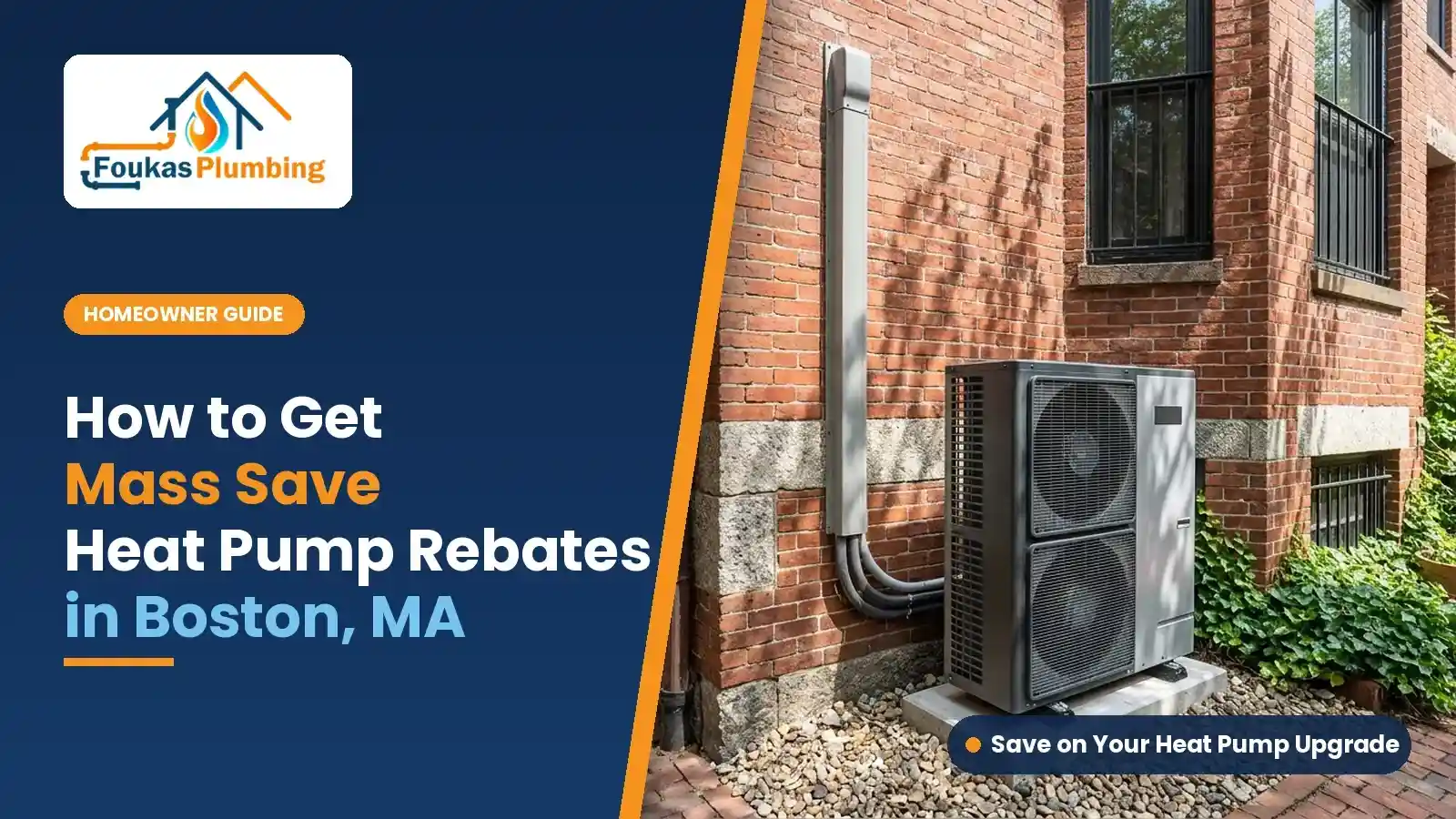
In 2026, Boston homeowners served by Eversource, National Grid or Unitil can get a Mass Save rebate of $2,650 per ton (up to $8,500) for a whole-home heat pump, or $1,125 per ton (up to $8,500) for a partial-home system. To qualify, use equipment on the Mass Save Heat Pump Qualified Products List, hire a participating installer, meet weatherization rules and submit the rebate after installation. A 0% Mass Save HEAT Loan can cover the rest.
What Is the Mass Save Heat Pump Rebate?
Mass Save is the energy efficiency program funded by Massachusetts utility customers and run by the state’s investor-owned utilities, including Eversource, National Grid and Unitil. Its rebates lower the upfront cost of replacing oil, propane, gas or electric resistance heat with a cold-climate air-source heat pump that heats in winter and cools in summer.
For a Boston home, that usually means a ducted system, ductless mini-splits, or a mix of both, and the right choice depends on your layout, existing ductwork and budget. Our heat pump services in Boston, MA, cover all three options. The rebate is paid per ton of heating capacity (one ton equals 12,000 BTUs), so the size and type of system directly decide how much you receive.
How Much Is the Mass Save Heat Pump Rebate in 2026?
The 2026 amounts are lower than last year’s. The whole-home rebate dropped from $3,000 per ton (capped at $10,000) in 2025 to $2,650 per ton (capped at $8,500). There is also no federal heat pump tax credit in 2026, which makes the Mass Save rebate the main incentive for most Boston homeowners.
| Rebate tier | 2026 amount | Who it fits |
| Whole-home air-source heat pump | $2,650 per ton, up to $8,500 | Heat pump becomes the only heating and cooling system; the old fossil-fuel system is removed or disconnected |
| Partial-home air-source heat pump | $1,125 per ton, up to $8,500 | Heat pump works alongside an existing boiler or furnace with integrated controls |
| Basic heat pump | $250 per ton, up to $2,500 | Replacing an older heat pump with a new one |
| Heat pump water heater | $750 | ENERGY STAR certified hybrid water heater |
| Income-eligible enhanced offer | Up to $16,000, or no-cost installs for the lowest income tier | Qualifying households |
| Mass Save HEAT Loan | 0% financing up to $25,000 | Eligible upgrades, including heat pumps |
Amounts reflect the 2026 Mass Save program. Rebates change, so confirm current figures on the official Mass Save website before you sign a contract.
Who Qualifies for Mass Save in Boston and the North Shore?
You qualify if your home’s electricity or gas comes from a Mass Save utility. In Boston, Cambridge, Somerville, Medford, Revere, Everett, Lynn and Salem, that covers most homeowners.
Some nearby towns are different. Communities served by a municipal light plant, such as Peabody, Danvers, Marblehead, Belmont, Concord, Wellesley, Lynnfield and Wakefield, do not pay into Mass Save for electricity, so their electric customers usually use their own municipal heat pump programs instead. If your home in one of those towns heats with National Grid gas, you may still be able to access some Mass Save measures, as the Massachusetts Department of Energy Resources explains. Check the name on your electric and gas bills before you plan the project.
Your equipment and home also need to meet program rules:
- The heat pump must appear on the Mass Save Heat Pump Qualified Products List (HPQPL)
- Systems using older R-410A refrigerant no longer qualify in 2026
- Whole-home projects need a load calculation sizing the system to your home’s heating needs, adequate insulation and air sealing, and a signed Whole-Home Heat Pump Verification Form
- A participating, Mass Save certified installer must complete the work
How to Get Your Mass Save Heat Pump Rebate, Step by Step
1. Book a no-cost Mass Save home energy assessment
The assessment identifies insulation and air-sealing gaps. Mass Save covers 75% of recommended insulation costs for most homeowners and 100% for income-eligible households, which also helps you meet whole-home weatherization rules.
2. Choose a certified heat pump installer
Ask for a room-by-room heat load calculation, not a rule-of-thumb estimate. Oversized systems short-cycle; undersized systems fall back on expensive backup heat during a Boston cold snap.
3. Pick qualifying equipment and the right rebate tier
Your installer should confirm every outdoor and indoor unit is on the HPQPL and explain whether a whole-home or partial-home design fits your house and budget.
4. Weatherize before or with the install
Older Boston homes, especially triple-deckers and colonials in Dorchester, Brighton and East Boston, often need attic and wall insulation before a whole-home heat pump makes sense.
5. Complete the heat pump installation and decommissioning
For the whole-home tier, the existing oil, propane or gas heating system must be removed or disconnected.
6. Submit the rebate application
Submit after installation with the invoice, equipment model and AHRI numbers and any required verification form. Keep copies of everything.
7. Finance the balance with the HEAT Loan
The Mass Save HEAT Loan offers 0% financing for eligible upgrades, so the remaining cost can be spread out without interest.
How the Math Works for a Boston Home
Take a typical 2,000 square foot single-family home in Dorchester heated by an aging oil boiler. A load calculation shows the home needs about 3 tons of heating capacity.
- Whole-home path: 3 tons × $2,650 = $7,950 rebate. A larger home needing 4 tons would hit the $8,500 cap.
- Partial-home path: if the owner keeps the boiler as backup, 3 tons × $1,125 = $3,375 rebate.
On a $16,000 whole-home project, an $8,500 rebate leaves $7,500. Financed with a 0% HEAT Loan over 84 months, that works out to roughly $89 a month, before any savings on oil.
Heat Pump Water Heaters, Tankless Gas Water Heaters and Mass Save
A heat pump (hybrid) water heater pulls heat from the surrounding air and qualifies for a $750 Mass Save rebate. We install them in basements across Greater Boston through our heat pump water heater service.
A tankless gas water heater is a different technology. It burns natural gas or propane on demand, so it is not part of the heat pump rebate program. It can still be a smart choice for some homes, and our tankless water heater installation team can help you compare the two.
Heat Pump vs Boiler Replacement or Furnace Installation
Many homeowners call us when an old boiler or furnace fails, usually in January. Before you decide, compare the full picture:
- Boiler replacement cost: a like-for-like boiler swap does not earn a Mass Save heat pump rebate. A partial-home heat pump paired with a new or existing boiler can, and it cuts how often the boiler runs. Our boiler replacement service covers both options.
- Furnace installation: if your home already has good ductwork, a ducted heat pump can often reuse it. Where a new furnace is the better fit, our furnace installation team installs high-efficiency systems.
- Emergencies: if your heat stops in the middle of winter, our 24/7 emergency service gets your home warm first. Need 24-hour furnace installation help? Call us and we will lay out every option, including a heat pump that may still qualify for a rebate.
Common Mistakes That Cost Boston Homeowners Their Rebate
- Installing equipment that is not on the HPQPL
- Choosing an R-410A system in 2026
- Skipping weatherization on a whole-home project
- Keeping the old system connected but applying for the whole-home tier
- Hiring an installer who is not enrolled with Mass Save
- Missing paperwork such as AHRI numbers or the verification form
Why Work with a Certified Mass Save Installer
Foukas Plumbing & Heating is a certified Mass Save heat pump installer and a family-owned team with more than 40 years of experience in Greater Boston and the North Shore. Paul Foukas Sr. is a Master Plumber (License 13642) and a former plumbing, gas and mechanical inspector. Paul Foukas Jr. is a Master Plumber (License 17095), Construction Supervisor and Oil Burner Technician. That inspection background means your heat pump installation is designed to pass code and rebate review the first time.
We handle the full project: load calculation, equipment selection, installation, old system removal and rebate paperwork. Learn more on our heat pump installation and Mass Save pages.
Frequently Asked Questions
How much is the Mass Save heat pump rebate in 2026?
The whole-home rebate is $2,650 per ton, capped at $8,500. The partial-home rebate is $1,125 per ton, also capped at $8,500, and a basic tier pays $250 per ton up to $2,500.
Do I have to remove my oil or gas boiler to get the rebate?
Only for the whole-home tier. If you keep your boiler as backup, you can still qualify for the partial-home rebate with integrated controls.
Can I get a Mass Save rebate in Peabody, Danvers or Marblehead?
Usually not for electric heat pumps, because these towns are served by municipal light plants. Their electric customers typically use local rebate programs instead.
Does a tankless gas water heater qualify for the heat pump rebate?
No. Only heat pump (hybrid) water heaters qualify for the $750 heat pump water heater rebate. Mass Save’s gas-side offers change over time, so check masssave.com for any current gas water heater incentives.
Is there a federal tax credit for heat pumps in 2026?
No. The federal heat pump tax credit is no longer available in 2026, so Mass Save rebates and the HEAT Loan are the main incentives.
Get Your Mass Save Heat Pump Rebate Without the Guesswork
Want to know exactly how much you can save? Call Paul Jr. at (978) 332-6857 or Paul Sr. at (857) 251-2509, or request a free estimate. We will size your system, confirm your rebate tier and handle the paperwork.